It's spring, and it’s safe to come out now. There are still a few wisps of snow here and there on the ground, but one good rain and it will be gone. There are birds in profusion and a few squirrels scurry about, but so far no flower or shrub has dared to bloom, a good thing, because it was well below freezing last night.
The other day I saw a flock of confused geese flying south, down the coast. Do they know something we don’t? Has the climate in Labrador become suddenly hostile? Does Al Gore know about this?
One of these days I will take my bike off its hook in the garage, fill the tires with air, squirt some oil on the axles, don the yellow helmet my safety-minded daughter gave me, and pedal down the dirt road to the paved street and along the beachfront. For a month or two this will be the ideal exercise, then the paved street will be jammed with cars that leave little room for cyclists, and the bike rides will be chancy, helmet or not.
The snowbirds will come back, and we will be glad to see them. The same can’t be said of the evil seagull, which I swear I saw the other day. As recounted in “The Seagull Wars,” this monster destroyed two screen sliders and otherwise terrorized this house last summer. Now, it appears, he’s ba-ack, and the war goes on – endlessly, it appears, just like Iraq.
The wind is up most of the time, cold from the north, and the seas are choppy. Peak gusts have topped 40 mph on many days lately – strong enough to send trash barrels rolling down the road and ripping the globe from one of the patio lights along our driveway. The beach is still deserted and a joy to walk, but a good jacket is a must, no matter what the thermometer says.
The sky has been a spectacular blue in recent days, with not a trace of a cloud from horizon to horizon, another byproduct of those stiff winds. That pristine sky is shown on the cover of my book, “Searching for Joan Leslie’ (available at lulu.com), and it looks like computer-generated trickery, but no, that’s the sky as it was when my son snapped the picture. All he had to do was add the copy.
In the early evening that bright beacon in the western sky is Venus. It doesn’t hang around very long, but it’s a dazzler. I wonder if the Venusians can look up at their night sky and see Earth, 67 million miles away. Probably not; I read somewhere that it is always cloudy on Venus.
Saturday, March 31, 2007
Wednesday, March 28, 2007
The Tipping Point
By now you must know that half of all income taxes are paid by 5 percent of all taxpayers. No one seems very agitated about this, especially these days when income inequality is such a hot topic along the campaign trail.
Should we be concerned about the top-loading of our income-tax distribution? We should, but not out of pity for all those investment bankers with their huge bonuses. The real problem lies at the other end of the scale. We should be uneasy about the threat to our democratic system presented by the fact that a large and increasing percentage of all voters pay little or no income taxes.
Throughout the last two decades, Congress – Democrats and Republicans alike – has steadily raised the no-tax threshold, excusing more and more voters from paying the cost of running their government. We are now closing in on the tipping point – the point where 51 percent of all voters pay little or no income taxes.
The implications are ominous: Once a majority of voters have no personal stake in the cost of their government, self-interest will lead them to elect representatives who will increase entitlements without limit. That’s where the system goes ballistic, needing more and more tax revenues – always to be paid by someone else – to support more and more services. If the majority could put the whole load on Bill Gates, they would, but that wouldn’t work, so taxes on the minority will have to rise. And rise.
It wasn’t supposed to be that way. But a century of income taxes, the graduated kind, has inevitably brought us here. Candidates demagogue the issue, pushing for more “progressive” taxes, in effect promising more voters a free ride. The latest variation on the theme is to promise to rejigger the tax laws to bring relief to the middle class, which is usually undefined but assumed to be wherever the votes are. (One remembers Speaker of the House Tip O’Neill setting the upper boundary of the middle class at an income level of $50,000 a year, a mindset that led Congress to impose the Alternative Minimum Tax.)
We are on a slippery slope. It may be too late to head off the threat to our democracy that our lopsided tax distribution system poses. Our only hope is that a card-carrying liberal Democratic president comes out strongly in favor of a flat tax. Only he (or she) could make it happen.
Don’t hold your breath.
Should we be concerned about the top-loading of our income-tax distribution? We should, but not out of pity for all those investment bankers with their huge bonuses. The real problem lies at the other end of the scale. We should be uneasy about the threat to our democratic system presented by the fact that a large and increasing percentage of all voters pay little or no income taxes.
Throughout the last two decades, Congress – Democrats and Republicans alike – has steadily raised the no-tax threshold, excusing more and more voters from paying the cost of running their government. We are now closing in on the tipping point – the point where 51 percent of all voters pay little or no income taxes.
The implications are ominous: Once a majority of voters have no personal stake in the cost of their government, self-interest will lead them to elect representatives who will increase entitlements without limit. That’s where the system goes ballistic, needing more and more tax revenues – always to be paid by someone else – to support more and more services. If the majority could put the whole load on Bill Gates, they would, but that wouldn’t work, so taxes on the minority will have to rise. And rise.
It wasn’t supposed to be that way. But a century of income taxes, the graduated kind, has inevitably brought us here. Candidates demagogue the issue, pushing for more “progressive” taxes, in effect promising more voters a free ride. The latest variation on the theme is to promise to rejigger the tax laws to bring relief to the middle class, which is usually undefined but assumed to be wherever the votes are. (One remembers Speaker of the House Tip O’Neill setting the upper boundary of the middle class at an income level of $50,000 a year, a mindset that led Congress to impose the Alternative Minimum Tax.)
We are on a slippery slope. It may be too late to head off the threat to our democracy that our lopsided tax distribution system poses. Our only hope is that a card-carrying liberal Democratic president comes out strongly in favor of a flat tax. Only he (or she) could make it happen.
Don’t hold your breath.


Monday, March 26, 2007
The Literary Gourmand
I am inept in the kitchen, but I am married to a very ept lady, who cooks wonderful things. The latest wonderful thing is crab bisque, inspired by a dish we ate in a Sanibel restaurant in January. For some reason, the restaurants around here do not serve crab bisque, though there is lobster bisque aplenty and there is always clam chowder, which can range from watery to gummy. You will also find crab cakes on some menus, as well as crabmeat salads. But no crab bisque. So it was time for Jill to do her thing.
It started with a trip to the Food Network web site, which yielded an easy-looking recipe for something called Crabby Bisque, but it ended, as usual, with a variation on the theme. I do not exaggerate when I say that the final product gave new meaning to the term “to die for.” You may have found a useful tip or two if you’ve been reading this blog regularly, but what I am going to tell you now is the most valuable information you are likely to read this year.
Here’s what you will need:
2 15-oz cans of condensed lobster bisque, available at the supermarket under the Gordon’s Naturally Chesapeake label. (Now you see that we are dealing with crab/lobster bisque here.)
1 pint of heavy cream
1 lemon’s worth of lemon juice (squeeze a lemon; don’t buy juice)
2 dashes of tabasco
1 tablespoon of chopped fresh parsley
2 6-oz containers of fresh crabmeat (save a small amount for garnish)
Put the works into a blender, about 1-1/2 to 2 cups at a time, and blend away.
Heat, but do not boil. Serve with crabmeat garnish
That’s it. You will bless me for sharing this gem with you, and you will wonder how anything so simple can be so delicious.
It started with a trip to the Food Network web site, which yielded an easy-looking recipe for something called Crabby Bisque, but it ended, as usual, with a variation on the theme. I do not exaggerate when I say that the final product gave new meaning to the term “to die for.” You may have found a useful tip or two if you’ve been reading this blog regularly, but what I am going to tell you now is the most valuable information you are likely to read this year.
Here’s what you will need:
2 15-oz cans of condensed lobster bisque, available at the supermarket under the Gordon’s Naturally Chesapeake label. (Now you see that we are dealing with crab/lobster bisque here.)
1 pint of heavy cream
1 lemon’s worth of lemon juice (squeeze a lemon; don’t buy juice)
2 dashes of tabasco
1 tablespoon of chopped fresh parsley
2 6-oz containers of fresh crabmeat (save a small amount for garnish)
Put the works into a blender, about 1-1/2 to 2 cups at a time, and blend away.
Heat, but do not boil. Serve with crabmeat garnish
That’s it. You will bless me for sharing this gem with you, and you will wonder how anything so simple can be so delicious.
Saturday, March 24, 2007
Anthony Powell
We’ve talked about several of the great British authors of the last century or two – Waugh, Greene, Trollope, and others – and now it is time to address Anthony Powell, a true titan, a master of the novelist’s art – and a writer hardly known to the American public.
I was put onto Powell about 30 years ago, when at a financial conference in London I struck up a conversation with a British portfolio manager about – what else? – books. He told me, in a tone that reeked of triumphalism, that he had just finished reading Powell’s Dance to the Music of Time – a second time!! The full impact of this feat hit me only when I learned that Dance is not a book but a series of 12 novels spanning the period from just after World War 1 through two decades after World War 2. The period is well traveled, but Powell’s characters make it seem brand new.
Powell wrote the first novel in the series, A Question of Upbringing, in 1951, the twelfth, Hearing Secret Harmonies, in 1975. How many writers can labor on a single narrative for 24 years? Just keeping the characters straight is an achievement, especially as a character may enter in volume 3, exit in volume 4, and resurface in volume 11, by which time you may have forgotten all about him or her. I found this a problem as I worked my way through the 12 books, and I must also say that the best of the 12 are the first three or four and that the last few are the weakest. The series is nevertheless an impressive achievement and one of the literary landmarks of our time.
The novels begin by examining the friendship of four boys in an Eton-like school in the early twenties: the narrator, Nicholas Jenkins, his friends Charles Stringham and Peter Templer, and – unforgettably, Kenneth Widmerpool, one of the major comic creations of twentieth-century literature. At the outset Widmerpool’s cluelessly inane behavior seems to mark him as comic relief, but by the end of the series, the buffoon emerges as a darker, more threatening presence.
Powell (rhymes with pole, not with towel) lived a long, productive life, which ended in 2000 when he was 95. There were many other novels (his first was published in 1931), biographies, critical essays, and at least two plays. He was a contemporary of Waugh and Greene at Oxford. In World War 2 he worked for British Intelligence, and the three Dance volumes dealing with the War are widely regarded as among the best covering that territory.
There is something about a novel series that is especially satisfying. Finish one good read, then greet many of the same characters again in a new book, and so on, until the whole tapestry is hung – at which point you feel either relief or loss, depending on the quality of the story. Some of Dickens’s and Trollope’s best works first appeared as serials in newspapers, with readers anxiously awaiting each new episode. The literary serial seems to be out of style today, the nearest counterpart being a television series like Upstairs, Downstairs or Dallas.
Anthony Powell’s Dance to the Music of Time, ideal miniseries material, was in fact produced for television in England about 10 years ago. The cast included John Gielgud, Edward Fox, and Zoë Wannamaker. The 50-year span was compressed into four two-hour segments, and reports from abroad say it was superb. For now, we’ll have to take their word for it; the series was never aired in the U.S., nor is it available in the standard (NTSC) format for American VCRs or DVDs. If you have a player that can handle the British format (PAL), you can probably find a tape or disc at Amazon or eBay.
I was put onto Powell about 30 years ago, when at a financial conference in London I struck up a conversation with a British portfolio manager about – what else? – books. He told me, in a tone that reeked of triumphalism, that he had just finished reading Powell’s Dance to the Music of Time – a second time!! The full impact of this feat hit me only when I learned that Dance is not a book but a series of 12 novels spanning the period from just after World War 1 through two decades after World War 2. The period is well traveled, but Powell’s characters make it seem brand new.
Powell wrote the first novel in the series, A Question of Upbringing, in 1951, the twelfth, Hearing Secret Harmonies, in 1975. How many writers can labor on a single narrative for 24 years? Just keeping the characters straight is an achievement, especially as a character may enter in volume 3, exit in volume 4, and resurface in volume 11, by which time you may have forgotten all about him or her. I found this a problem as I worked my way through the 12 books, and I must also say that the best of the 12 are the first three or four and that the last few are the weakest. The series is nevertheless an impressive achievement and one of the literary landmarks of our time.
The novels begin by examining the friendship of four boys in an Eton-like school in the early twenties: the narrator, Nicholas Jenkins, his friends Charles Stringham and Peter Templer, and – unforgettably, Kenneth Widmerpool, one of the major comic creations of twentieth-century literature. At the outset Widmerpool’s cluelessly inane behavior seems to mark him as comic relief, but by the end of the series, the buffoon emerges as a darker, more threatening presence.
Powell (rhymes with pole, not with towel) lived a long, productive life, which ended in 2000 when he was 95. There were many other novels (his first was published in 1931), biographies, critical essays, and at least two plays. He was a contemporary of Waugh and Greene at Oxford. In World War 2 he worked for British Intelligence, and the three Dance volumes dealing with the War are widely regarded as among the best covering that territory.
There is something about a novel series that is especially satisfying. Finish one good read, then greet many of the same characters again in a new book, and so on, until the whole tapestry is hung – at which point you feel either relief or loss, depending on the quality of the story. Some of Dickens’s and Trollope’s best works first appeared as serials in newspapers, with readers anxiously awaiting each new episode. The literary serial seems to be out of style today, the nearest counterpart being a television series like Upstairs, Downstairs or Dallas.
Anthony Powell’s Dance to the Music of Time, ideal miniseries material, was in fact produced for television in England about 10 years ago. The cast included John Gielgud, Edward Fox, and Zoë Wannamaker. The 50-year span was compressed into four two-hour segments, and reports from abroad say it was superb. For now, we’ll have to take their word for it; the series was never aired in the U.S., nor is it available in the standard (NTSC) format for American VCRs or DVDs. If you have a player that can handle the British format (PAL), you can probably find a tape or disc at Amazon or eBay.
Tuesday, March 20, 2007
Searching for Joan Leslie
I am happy to say that the printing problems in "Searching for Joan Leslie" have been resolved, and any copies ordered from now on should be bug-free. The book is a 184-page, 6 by 9 paperback containing most of the blog postings of the past year, edited and organized by subject. To learn more, go to www.lulu.com and search under "Van Veen".
Monday, March 19, 2007
The Book (cont'd)
Noting some bugs in the first edition of "Searching for Joan Leslie," I uploaded a new version. The bugs were removed, but a few new ones (some dropped copy) mysteriously crept in. They are not on the pdf, so the problem is with the printer. We'll get it sorted out soon, but meanwhile, I suggest holding off on ordering your copies. I'll let you know when all is well.
Thursday, March 15, 2007
The Tragedy of Iraq
It is fashionable in some circles, especially European circles, to take George W. Bush for a fool. I don’t subscribe to this view. I watch his press conferences, the give-and-take with the Washington press corps, all primed with their gotchas, and I see a quick-thinking, rational, intelligent speaker. Sure, his talking points are well rehearsed, but there is enough off-the-cuff repartee to convince me that this man is no fool.
And that makes the Iraq situation doubly tragic. Given the performance of the economy, George W. would be an immensely popular national and world leader today if it weren’t for one egregious misstep: his decision to invade Iraq.
To be sure, there are those of the other political persuasion who would try to make the most out of income inequality, Hurricane Katrina, and the loss of manufacturing jobs. But they would be swept aside under the weight of the facts: low unemployment, low interest rates, high stock prices. Sans Iraq, our President would be walking on water.
Instead, he is drowning. The opposition has in Iraq a weapon of political mass destruction. Congress has been lost, and W’s economic policies are imperiled. His defense secretary resigned in near disgrace, his Vice President’s aide has just been convicted of perjury, his attorney general may be hounded out of office.
Iraq wasn’t a minor mistake. It was, as the President’s enemies charge, the greatest foreign policy blunder in recent memory. Its negative effects will outlive us all. It has made a good portion of the world despise us. It has cost us thousands of lives and hundreds of billions of dollars. More than 100,000 Iraqis are dead because we insisted on liberating them. Not least, it has deepened the political divide in this country and sabotaged the President’s own party and his domestic agenda.
George W. Bush now sits at the center of a tragedy as profound as any of Shakespeare’s. As you will remember, the protagonist of every Shakespearean tragedy owed his destruction to some fatal character flaw. What was Bush’s flaw? History will render its judgment, but here’s a stab at it: The President authorized the invasion of Iraq, not because he was dumb, but because he was weak. Surrounded by advisors pushing for invasion, he put aside his own misgivings (I’m sure he had them) and went with the neocon flow. He was Macbeth giving in to the urgings of his wife. Our tragedy is compounded by the fact that there is not, in either party, a Macduff in sight.
It’s an old story, even older than Vietnam. It’s easy to go to war, especially when you’re the Commander-in-Chief and Congress has forgotten that war is technically its prerogative. It looks macho, but it’s really a sign of weakness. A strong president would find the courage to say no to the hawks and yes to the diplomats.
The writer Kurt Anderson reminds us that in 1848 a young Congressman named Lincoln wondered aloud what the dickens the U.S. was doing invading Mexico. President Polk, Lincoln said, must explain the war “with facts and not with arguments…..But if he cannot….then I should be fully convinced that he is deeply conscious of being in the wrong, that he plunged into it and has swept on and on till, disappointed in his calculation of the ease with which Mexico might be subdued, he now finds himself, he knows not where.”
And that makes the Iraq situation doubly tragic. Given the performance of the economy, George W. would be an immensely popular national and world leader today if it weren’t for one egregious misstep: his decision to invade Iraq.
To be sure, there are those of the other political persuasion who would try to make the most out of income inequality, Hurricane Katrina, and the loss of manufacturing jobs. But they would be swept aside under the weight of the facts: low unemployment, low interest rates, high stock prices. Sans Iraq, our President would be walking on water.
Instead, he is drowning. The opposition has in Iraq a weapon of political mass destruction. Congress has been lost, and W’s economic policies are imperiled. His defense secretary resigned in near disgrace, his Vice President’s aide has just been convicted of perjury, his attorney general may be hounded out of office.
Iraq wasn’t a minor mistake. It was, as the President’s enemies charge, the greatest foreign policy blunder in recent memory. Its negative effects will outlive us all. It has made a good portion of the world despise us. It has cost us thousands of lives and hundreds of billions of dollars. More than 100,000 Iraqis are dead because we insisted on liberating them. Not least, it has deepened the political divide in this country and sabotaged the President’s own party and his domestic agenda.
George W. Bush now sits at the center of a tragedy as profound as any of Shakespeare’s. As you will remember, the protagonist of every Shakespearean tragedy owed his destruction to some fatal character flaw. What was Bush’s flaw? History will render its judgment, but here’s a stab at it: The President authorized the invasion of Iraq, not because he was dumb, but because he was weak. Surrounded by advisors pushing for invasion, he put aside his own misgivings (I’m sure he had them) and went with the neocon flow. He was Macbeth giving in to the urgings of his wife. Our tragedy is compounded by the fact that there is not, in either party, a Macduff in sight.
It’s an old story, even older than Vietnam. It’s easy to go to war, especially when you’re the Commander-in-Chief and Congress has forgotten that war is technically its prerogative. It looks macho, but it’s really a sign of weakness. A strong president would find the courage to say no to the hawks and yes to the diplomats.
The writer Kurt Anderson reminds us that in 1848 a young Congressman named Lincoln wondered aloud what the dickens the U.S. was doing invading Mexico. President Polk, Lincoln said, must explain the war “with facts and not with arguments…..But if he cannot….then I should be fully convinced that he is deeply conscious of being in the wrong, that he plunged into it and has swept on and on till, disappointed in his calculation of the ease with which Mexico might be subdued, he now finds himself, he knows not where.”
Saturday, March 10, 2007
The Beachcomber's New Book
If you enjoy these blogs, you may be interested to learn that most of the postings of the past year are now available in book form. The book is called “Searching for Joan Leslie,” and it is published by lulu.com. It is a paperback, in 6 by 9 format, and it will cost you $10 plus shipping. It will appeal to a very small, very select audience, and only the magic of on-line publishing makes such a book economically feasible. From royalties off the book sales, I expect to net enough to buy lunch at the Olive Garden, if I don’t eat too much.
To learn more, go to http://www.lulu.com. Then search under "Van Veen".
To learn more, go to http://www.lulu.com. Then search under "Van Veen".
Friday, March 09, 2007
Six Guys Named Vinnie
For a people who pride ourselves on our ability to speak freely, we have become awfully sensitive lately. The latest in a series of absurdities that seems to have no end involves the man who is slated to become the next head of the New York Stock Exchange. He is an ardent advocate of eliminating human specialists from the floor of the Exchange and replacing them with computers – an entirely sensible idea, since the specialists’ function is the sort of mathematical job that computers should be able to do faster and with fewer errors.
In making his case in a recent speech, the man decided to use picturesque language. Specifically, he said that he personally would rather have his transactions handled by a computer than by “six guys named Vinnie.” No sooner had the words left his mouth than some members of the Italian-American community attacked him for making an ethnic slur.
What’s going on here? Who says Vinnie is Italian? All the Vinnies I knew growing up were Irish. Vincent Van Gogh was not Italian, nor was Vincent Price. In the funny TV commercial for TV blockers, Vinnie is the guy hit over the head with a shovel, not the hit man. The only Vinnie I can think of that fills the bill is My Cousin Vinnie, a good-hearted Italian-American lawyer.
And should we all assume that the Big Board specialists are disproportionately Italian? If so, so what? I don’t understand the thought train at work here. The speaker was not talking about six drug dealers or six child-abusers; he was talking about six stock-exchange specialists. I doubt that little kids, even in Brooklyn, taunt each other with “Your old man’s a stock-market specialist!” – much less, “Your old man’s an Italian stock-market specialist!”
In the YouTube era, it is possible to catch virtually anyone saying something that someone can consider offensive. If you are living, breathing, moving, and talking, you are leaving a film trail that someone can use against you. It can be any word or phrase that can be deemed “insensitive.” If you didn’t know you were being insensitive, that’s even worse; it just proves you’re insensitive to insensitivity, which is insensitivity squared.
Yes, there are instances when words can be hurtful, but the First Amendment does not protect only unhurtful speech. It is supposed to protect speech that is stupid, inflammatory, and even hurtful. Speech is either free or not free; it cannot be free with exceptions.
What about someone who yells “Fire!” in a crowded theater? Yes, that’s wrong, but not because the word is wrong. The act is wrong. Yelling “Flood!” or “Cockroaches!” would be just as bad. There is no insensitivity at issue here, only the act of creating panic. It’s a fine distinction, but an important one.
It all started, I suppose, back at the dawn of the civil-rights era, although you could also blame the birth of feminism, when Mizz was in and Mrs. was out, and girls were out and young women were in. Suddenly, everyone in America was a member of an aggrieved class, with lawyers urging them on, because you can’t have class-action suits without classes. It would not surprise me to learn that some lawyer is busily recruiting men named Vinnie to pursue a class-action suit against the New York Stock Exchange, which has the deep pockets that are essential in such matters.
Now that we are entering the presidential campaign of 2008, we will be treated to an avalanche of stories about candidates making insensitive remarks. Even now, legions of campaign workers are scouring YouTube and similar sources for ammunition. Mostly, they need victims. Today it is Vinnie. Tomorrow it will be Sol or Pat or Pedro. Since the heinous remark will be caught on tape, denial is impossible, so an apology will follow. We will thus be drowned in a flood of tearful apologies, but they will not be enough for the offended, who will ask – nay, demand - that the offender’s party repudiate the remark or, preferably, boil the offender in oil.
________________________
“I look forward to that happy day when blacks, negroes, colored people, and blacks can all live in peace and harmony together.” -------Steve Martin
In making his case in a recent speech, the man decided to use picturesque language. Specifically, he said that he personally would rather have his transactions handled by a computer than by “six guys named Vinnie.” No sooner had the words left his mouth than some members of the Italian-American community attacked him for making an ethnic slur.
What’s going on here? Who says Vinnie is Italian? All the Vinnies I knew growing up were Irish. Vincent Van Gogh was not Italian, nor was Vincent Price. In the funny TV commercial for TV blockers, Vinnie is the guy hit over the head with a shovel, not the hit man. The only Vinnie I can think of that fills the bill is My Cousin Vinnie, a good-hearted Italian-American lawyer.
And should we all assume that the Big Board specialists are disproportionately Italian? If so, so what? I don’t understand the thought train at work here. The speaker was not talking about six drug dealers or six child-abusers; he was talking about six stock-exchange specialists. I doubt that little kids, even in Brooklyn, taunt each other with “Your old man’s a stock-market specialist!” – much less, “Your old man’s an Italian stock-market specialist!”
In the YouTube era, it is possible to catch virtually anyone saying something that someone can consider offensive. If you are living, breathing, moving, and talking, you are leaving a film trail that someone can use against you. It can be any word or phrase that can be deemed “insensitive.” If you didn’t know you were being insensitive, that’s even worse; it just proves you’re insensitive to insensitivity, which is insensitivity squared.
Yes, there are instances when words can be hurtful, but the First Amendment does not protect only unhurtful speech. It is supposed to protect speech that is stupid, inflammatory, and even hurtful. Speech is either free or not free; it cannot be free with exceptions.
What about someone who yells “Fire!” in a crowded theater? Yes, that’s wrong, but not because the word is wrong. The act is wrong. Yelling “Flood!” or “Cockroaches!” would be just as bad. There is no insensitivity at issue here, only the act of creating panic. It’s a fine distinction, but an important one.
It all started, I suppose, back at the dawn of the civil-rights era, although you could also blame the birth of feminism, when Mizz was in and Mrs. was out, and girls were out and young women were in. Suddenly, everyone in America was a member of an aggrieved class, with lawyers urging them on, because you can’t have class-action suits without classes. It would not surprise me to learn that some lawyer is busily recruiting men named Vinnie to pursue a class-action suit against the New York Stock Exchange, which has the deep pockets that are essential in such matters.
Now that we are entering the presidential campaign of 2008, we will be treated to an avalanche of stories about candidates making insensitive remarks. Even now, legions of campaign workers are scouring YouTube and similar sources for ammunition. Mostly, they need victims. Today it is Vinnie. Tomorrow it will be Sol or Pat or Pedro. Since the heinous remark will be caught on tape, denial is impossible, so an apology will follow. We will thus be drowned in a flood of tearful apologies, but they will not be enough for the offended, who will ask – nay, demand - that the offender’s party repudiate the remark or, preferably, boil the offender in oil.
________________________
“I look forward to that happy day when blacks, negroes, colored people, and blacks can all live in peace and harmony together.” -------Steve Martin
Tuesday, March 06, 2007
The Departed
The South Boston Irish, warts and all, make up the world of Martin Scorcese’s The Departed. They like to drink and womanize, they go to church a lot, and they are capable of turning on each other suddenly and violently, They live and die fatalistically, as if it’s no big deal to kill or be killed, because, as Frank Costello (Jack Nicholson) says, when told someone’s old mother is on the way out, “so are we all.”
The Southie of The Departed is not the Southie my Dad always talked about. His Southie was a place of bonding for life. If you were from Southie, you were the salt of the earth. So said my Dad, and on this subject more than any other, his word could be taken to the bank.
But Martin Scorcese was not making a morality play about South Boston. He was making a cops and robbers entertainment, the kind of movie that used to pair Jimmy Cagney and Pat O’Brien, and in this he succeeded brilliantly. Few movies that run for 2-1/2 hours can keep you from looking at your watch along the way (or falling asleep), but in this case the challenge is to keep from falling off the edge of your chair. Two young men, played to perfection by Matt Damon and Leonardo diCaprio, play two moles – one working inside the Massachusetts State Police for crime boss Costello, the other working for the police inside the Costello gang. As Costello and the police try to identify the rats in their midst, the tension rises, and by the end, almost every actor playing a central character in The Departed turns out to be playing the title role.
Most of the film was shot in Boston, very credibly. The three-deckers, the corner groceries, the hahbah, City Hall, the State House, the subway, the Central Ahtery, all are there. All that was missing was a scene shot at Fenway Pahk or the Boston Gahden. Two of the key actors, Matt Damon and Mark Wahlberg, are native Bostonians, which added to the authenticity. These and the other members of the excellent cast are all clones of characters I ran across every day while spending the first 25 years of my life in Boston. Even their names – Billy Costigan, Frank Costello, Colin Sullivan – sounded eerily familiar. And the scriptwriter just had to be a Billy Monihan.
A few days after watching the movie, Jill and I were driving through Norwood, just south of Boston, when we noticed a funeral gathering by the big Catholic church in the center, St. Catherine’s. The crowd waiting outside the church was made up mostly of young men, sad-faced and tall and splendid in their black suits.
“I wonder who died,” I said as we drove by.
Jill, sizing up the scene, figured it out on the spot.
“Billy Costigan.”
It is a bloody, extremely violent film, in which the only adjectives permitted are four-letter words and their derivatives. The few women in the story exist only as playthings for the men. But the characters in this world act and talk like that. You will not like most of them, but that’s beside the author’s point.
The Departed won the Oscar as Best Picture, and I can’t argue with that. Of the nominees, I saw The Queen (excellent) and Little Miss Sunshine (good, but vastly overpraised). In that small sample, The Departed stood out for its script, ensemble acting, and direction (another Oscar, for Scorcese). I plan to see The Last King of Scotland, another essentially unsavory story about evil men doing evil deeds. Amin wouldn’t have lasted long in Southie, or Costello in Uganda, but from what I have read, the two were cut from the same cloth.
The Southie of The Departed is not the Southie my Dad always talked about. His Southie was a place of bonding for life. If you were from Southie, you were the salt of the earth. So said my Dad, and on this subject more than any other, his word could be taken to the bank.
But Martin Scorcese was not making a morality play about South Boston. He was making a cops and robbers entertainment, the kind of movie that used to pair Jimmy Cagney and Pat O’Brien, and in this he succeeded brilliantly. Few movies that run for 2-1/2 hours can keep you from looking at your watch along the way (or falling asleep), but in this case the challenge is to keep from falling off the edge of your chair. Two young men, played to perfection by Matt Damon and Leonardo diCaprio, play two moles – one working inside the Massachusetts State Police for crime boss Costello, the other working for the police inside the Costello gang. As Costello and the police try to identify the rats in their midst, the tension rises, and by the end, almost every actor playing a central character in The Departed turns out to be playing the title role.
Most of the film was shot in Boston, very credibly. The three-deckers, the corner groceries, the hahbah, City Hall, the State House, the subway, the Central Ahtery, all are there. All that was missing was a scene shot at Fenway Pahk or the Boston Gahden. Two of the key actors, Matt Damon and Mark Wahlberg, are native Bostonians, which added to the authenticity. These and the other members of the excellent cast are all clones of characters I ran across every day while spending the first 25 years of my life in Boston. Even their names – Billy Costigan, Frank Costello, Colin Sullivan – sounded eerily familiar. And the scriptwriter just had to be a Billy Monihan.
A few days after watching the movie, Jill and I were driving through Norwood, just south of Boston, when we noticed a funeral gathering by the big Catholic church in the center, St. Catherine’s. The crowd waiting outside the church was made up mostly of young men, sad-faced and tall and splendid in their black suits.
“I wonder who died,” I said as we drove by.
Jill, sizing up the scene, figured it out on the spot.
“Billy Costigan.”
It is a bloody, extremely violent film, in which the only adjectives permitted are four-letter words and their derivatives. The few women in the story exist only as playthings for the men. But the characters in this world act and talk like that. You will not like most of them, but that’s beside the author’s point.
The Departed won the Oscar as Best Picture, and I can’t argue with that. Of the nominees, I saw The Queen (excellent) and Little Miss Sunshine (good, but vastly overpraised). In that small sample, The Departed stood out for its script, ensemble acting, and direction (another Oscar, for Scorcese). I plan to see The Last King of Scotland, another essentially unsavory story about evil men doing evil deeds. Amin wouldn’t have lasted long in Southie, or Costello in Uganda, but from what I have read, the two were cut from the same cloth.
Friday, March 02, 2007
Ethan Mordden on Musicals

As any reader of these posts knows by now, I have long been a follower of musical theater. I have seen most of the classics, many of them in their original Broadway incarnations. My shelves are crammed with original-cast CDs and LPs, video tapes, and DVDs. My heroes are Richard Rodgers, Irving Berlin, John Kander, Fred Ebb, Stephen Sondheim, George Gershwin, Jerome Kern, and their contemporaries who gave us so many wonderful memories. I have read their biographies. I play their songs on my piano.
I take my children to musicals every chance I get, and I rattle on about them when we are together. As a result, they probably think their dad knows more than anyone alive about musical theater. Sorry, kids, but a man named Ethan Mordden knows a thousand times as much about musicals as I do. His knowledge is encyclopedic, and, what’s more, he is a fine writer. If you have even a wisp of interest in the subject, I strongly recommend his series of books on Broadway musicals. The more familiar you are with the great and not-so-great shows, the more you will get out of the books, but even if you’re only dimly aware of South Pacific and The Sound of Music, you’ll enjoy the stories.
The six books in the series cover six decades, to wit:
Make Believe; The Broadway Musical in the 20s.
Sing for Your Supper: The Broadway Musical in the 30s.
Beautiful Mornin’: The Broadway Musical in the 40s.
Coming Up Roses: The Broadway Musical in the 50s.
Open a New Window: The Broadway Musical in the 60s.
One More Kiss: The Broadway Musical in the 70s.
Most people believe that the golden age of the musical was the period from the 40s (Oklahoma!, Carousel) through the 60s (Cabaret, My Fair Lady), and the best of Mordden’s work are the three books covering those decades. As the century wound down, the musicals became less innovative, the music less melodic, the lyrics less clever, and Mordden skewers the musicals of the last 25 years in “The Happiest Corpse I’ve Ever Seen.” In this acerbic wrap-up, he doesn’t mince words: Musicals, he laments, have been going downhill, for a variety of reasons. (If you doubt this, consider the number of revivals playing the Great White Way these days.)
Mordden’s writing sparkles. Here, for instance, is an excerpt from his loving description of one of my favorites, the 1963 musical She Loves Me:
It’s a superb story superbly told, an acknowledged glory of the day. The Gay Life tells a good story, but it boasts a more outgoing score and enjoyed excellent production values. The production, now, is gone and the score just a cast album. She Loves Me is a classic, because it will always surprise a willing public. Remember my matinee ladies? As She Loves Me reaches its curtain, Georg and Amalia are leaving the store on Christmas Eve. They’re about to part company. But he knows that he’s Dear Friend. And we know that he’s Dear Friend. Now she has to know. So he quietly sings to her the words of the letter she composed during “Ice Cream.”
Now she knows.
And, as Barbara Cook turned to Daniel Massey with a look at once relieved, ecstatic, and terrified, the Eugene O’Neill Theater broke into tremendous applause even before Cook reached Massey’s arms for the curtain tableau.
I was waiting for that, those women were saying. You presented a lovely tale in a unique way, and now I realize that if I am to be stimulated, inspired, and touched, it needn’t be a musical play that does it. Musical comedy can have magic moments, too.
And here is some of what Mordden has to say about The Music Man:
Now a book scene fixes Hill up with an old crony, who warns him about the local music teacher and librarian, smart and a purist in everything. But Hill’s got a band to sell, and he smoothes into “Ya Got Trouble,” setting the plot proper in motion. Why, that pool table promises nothing less than the arrival of sin in River City! The good people of the town can only protect themselves by herding their youth into a marching band of …yes! Seventy-six trombones!
Okay, we’ve had a startling novelty in the salesmen’s rap number, a mock-traditional “opening” chorus of “merry” villagers – Sigmund Romberg gone sour - and the action has kicked in painlessly, naturally. One thing’s missing – the romance. No: Here comes the music teacher, to prim, self-righteous “walking” music. Hill follows her, masher-style. We’re on.
Clearly, one of The Music Man’s unique qualities is a resuscitation of a culture that, after two world wars, television, and Elvis Presley, had utterly disappeared. Knickers, pianola, cistern, corncrib, dime novels, “so’s your old man,” stereopticon slides, Montgomery Ward, canoodling, - a goodly portion of the show’s content had been retired to the American memory bank by the 1950s. Willson is telling a story that is all but faerie today.
Spending a couple of hours watching a talented company perform one of the classic musicals is one of life’s greatest pleasures. If you can’t get to a theater, listening to an original cast recording is the next best thing. Or reading one of these books and having the plays come to life on the printed page.
Thursday, March 01, 2007
The Lost City
Andy Garcia, I am told, has a checkered reputation among the Hollywood cognoscenti. I don’t know anything about that, and I frankly don’t care. What I do know is that his movie The Lost City shows a great deal of artistry, technical skill, and dedication. It is, in fact, a very good movie – not without flaws, which I will come to, but definitely worth watching.
The story is laid in Havana, just before and after Fidel Castro came to power. Garcia was born in Cuba, and in 1961, two years after the revolution, he and his family fled the island for good. Andy was six at the time. Once he became an established movie actor (in The Godfather) with connections, he began nurturing a vision of a movie dealing with the events of the Cuban revolution, set against the sights and sounds (especially the music) of his native land. The movie was released in 2005, and it came and went without much notice. The DVD is available, and that’s how I came upon it.
At the center of the story is a Law Professor at Havana University, his wife, and his three sons. The two younger sons are idealists being drawn into the Castro movement. The oldest son, Frederico (called Fico), strives to remain apolitical as he runs a Havana cabaret (thus the music). Fico wants nothing more than to keep the family together, but in this he is thwarted by the winds of change. The seizure of the palace and the flight of the dictator Batista are recreated believably, and the suffocating rule of the new regime is also on display. (“Remember,” lectures Che Guevara at one point, “the end justifies the means.”)
Garcia’s direction and his strong portrayal of Fico are impressive. The film has an epic look about it, with glorious cinematography (shot in the Dominican Republic) and authentically Cuban music, well performed. The actors playing Fico’s parents and his brothers are excellent, as is the Spanish actress Ines Sastre, who provides the love interest. The script, by Cabrera Infante, is intelligent and moving.
So what’s not to like?
Garcia apparently could not resist the opportunity to cast two “names” in two supporting roles. Bill Murray plays a has-been comedian who attaches himself to Fico and his cabaret, for reasons that are left unexplained. He adds nothing to the story or to the movie. Dustin Hoffman plays the mob leader Meyer Lansky. It’s a small part, and 100 other actors could have done it as well. Worse, it is clear during the “making of” feature, that Garcia indulged Murray and Hoffman inexcusably, allowing them to insert contrived business and lines. Hoffman is tolerable, Murray is not – although it is clear that Garcia thinks he pulled off a coup in hiring his Pebble Beach golf buddy.
The other failing is the film’s length. At the two-hour mark, Fico is flying out of Havana, escaping to New York and a new life, leaving the girl friend and his parents behind. It is a bittersweet moment, and it is also a perfect closing scene. But no. The story line follows Fico to New York, for 20 more minutes of anticlimactic scenes, some with the extra baggage of Bill Murray and Dustin Hoffman.
Think about the ending of Casablanca. Ingrid Bergman and Paul Henreid take off in the plane for Lisbon, while Humphrey Bogart and Claude Rains launch a beautiful friendship. Curtain. Would it have made sense to follow the fugitive couple to Lisbon and watch them set up housekeeping? I think not.
These criticisms aside, The Lost City is a movie you will not soon forget. In fact, it could assume cult status at some point, and in post-Castro Cuba it could become a landmark film, a must-see for all those interested in their country’s history.
And why did the movie fail to attract much attraction when it was released? Alas, it quickly became entangled in politics. Some South American governments reportedly banned it because they thought it showed Che in a bad light. It was stiffed by some film festivals, and many defenders of Fidel Castro attacked it. As I watched it, it seemed to me that both Batista and Castro were vilified, but apparently a right-wing dictator is fair game, a left-wing dictator is not.
The story is laid in Havana, just before and after Fidel Castro came to power. Garcia was born in Cuba, and in 1961, two years after the revolution, he and his family fled the island for good. Andy was six at the time. Once he became an established movie actor (in The Godfather) with connections, he began nurturing a vision of a movie dealing with the events of the Cuban revolution, set against the sights and sounds (especially the music) of his native land. The movie was released in 2005, and it came and went without much notice. The DVD is available, and that’s how I came upon it.
At the center of the story is a Law Professor at Havana University, his wife, and his three sons. The two younger sons are idealists being drawn into the Castro movement. The oldest son, Frederico (called Fico), strives to remain apolitical as he runs a Havana cabaret (thus the music). Fico wants nothing more than to keep the family together, but in this he is thwarted by the winds of change. The seizure of the palace and the flight of the dictator Batista are recreated believably, and the suffocating rule of the new regime is also on display. (“Remember,” lectures Che Guevara at one point, “the end justifies the means.”)
Garcia’s direction and his strong portrayal of Fico are impressive. The film has an epic look about it, with glorious cinematography (shot in the Dominican Republic) and authentically Cuban music, well performed. The actors playing Fico’s parents and his brothers are excellent, as is the Spanish actress Ines Sastre, who provides the love interest. The script, by Cabrera Infante, is intelligent and moving.
So what’s not to like?
Garcia apparently could not resist the opportunity to cast two “names” in two supporting roles. Bill Murray plays a has-been comedian who attaches himself to Fico and his cabaret, for reasons that are left unexplained. He adds nothing to the story or to the movie. Dustin Hoffman plays the mob leader Meyer Lansky. It’s a small part, and 100 other actors could have done it as well. Worse, it is clear during the “making of” feature, that Garcia indulged Murray and Hoffman inexcusably, allowing them to insert contrived business and lines. Hoffman is tolerable, Murray is not – although it is clear that Garcia thinks he pulled off a coup in hiring his Pebble Beach golf buddy.
The other failing is the film’s length. At the two-hour mark, Fico is flying out of Havana, escaping to New York and a new life, leaving the girl friend and his parents behind. It is a bittersweet moment, and it is also a perfect closing scene. But no. The story line follows Fico to New York, for 20 more minutes of anticlimactic scenes, some with the extra baggage of Bill Murray and Dustin Hoffman.
Think about the ending of Casablanca. Ingrid Bergman and Paul Henreid take off in the plane for Lisbon, while Humphrey Bogart and Claude Rains launch a beautiful friendship. Curtain. Would it have made sense to follow the fugitive couple to Lisbon and watch them set up housekeeping? I think not.
These criticisms aside, The Lost City is a movie you will not soon forget. In fact, it could assume cult status at some point, and in post-Castro Cuba it could become a landmark film, a must-see for all those interested in their country’s history.
And why did the movie fail to attract much attraction when it was released? Alas, it quickly became entangled in politics. Some South American governments reportedly banned it because they thought it showed Che in a bad light. It was stiffed by some film festivals, and many defenders of Fidel Castro attacked it. As I watched it, it seemed to me that both Batista and Castro were vilified, but apparently a right-wing dictator is fair game, a left-wing dictator is not.
Monday, February 26, 2007
The Oscars
The Academy Awards show has long been a platform for political messages. Most of us, I think, would prefer that actors stick to acting and leave the politicking to politicians, but this year the distinction was blurred by the multiple roles of Al Gore as (1) the highest ranking member of the Democratic Party on hand, (2) an Oscar winner, for An Inconvenient Truth, (3) an on-stage, on-camera advocate for tougher emission standards for the automobile industry, etc. and (4) the credited inspiration for several other Oscar winners, including the best-song winner, Melissa Etheridge. (You may well ask, “What is a song doing in a documentary on global warming anyway?”)
But that’s okay. By now we all have built-in filters that allow us to ignore all the Oscar’s sidebars, except the host’s monologue and the ladies’ dresses. Our filters block most commercials, the awards for short subjects and sound mixing, and the interminable lists of producers. But we can’t ignore the total incompetence of those Oscar winners who have trouble composing a succinct, coherent acceptance speech. Think of it: Here are people who have known for weeks or months that they were nominated, who moreover make their livings memorizing scripted lines, suddenly relying on a folded slip of paper and then tripping all over themselves trying to deliver four or five intelligible sentences.
The show’s audience is always worth a look, especially the celebrities who rate the choice aisle seats. (It would be fun to eavesdrop on the meetings where such things are decided.) But, filtering aside, it’s a classy event, an occasion at which the film industry shows respect for its craft and its craftsmen – as should we all, for, notwithstanding computers and iPods, movies remain our dominant entertainment medium.
For me, the appetizer for this year’s Oscar show was Christopher Guest’s latest movie, For Your Consideration, which describes the effect on the cast of a low-budget movie (Home for Purim) when it is rumored that one of the actors is under consideration for an Oscar nomination. The Christopher Guest troupe, so hilarious in Waiting for Guffman and Best in Show, is back. Unfortunately, the spirit that made those two movies so special is missing. Catherine O’Hara is fine as the subject of the rumor, as are Jennifer Coolidge as a clueless producer and Eugene Levy as a slimy agent, but the whole thing just doesn’t come off, possibly because Guest departed from his successful mockumentary format, possibly because the gang’s improv skills have been tapped out and it is time for a good script. There are some choice moments in the film, but Guest’s fans will be disappointed.
We should not leave the Oscars without commenting on this year’s host. Ellen DeGeneres was adequate. That’s not a knock; several hosts in recent years have been less than adequate. My own favorites were Steve Martin and Billy Crystal. Crystal seemed poised for a long run, but long runs – like that of Bert Parks in the Miss America pageant – are apparently not in the cards. Or maybe the Academy thinks Miss DeGeneres can build a following. Off this year’s performance, she deserves another shot.
Finally – also making it through our filter is the annual filmed tribute to those film personalities who died since the last Awards show. The list seems to get longer each year, which I suppose is only natural, but this year served up a bumper crop, including Maureen Stapleton, Glenn Ford, June Allyson, Jack Warden, Don Knotts, Jack Palance, Jane Wyman, and Alida Valli. They gave us many hours of entertainment and in fact still do.
But that’s okay. By now we all have built-in filters that allow us to ignore all the Oscar’s sidebars, except the host’s monologue and the ladies’ dresses. Our filters block most commercials, the awards for short subjects and sound mixing, and the interminable lists of producers. But we can’t ignore the total incompetence of those Oscar winners who have trouble composing a succinct, coherent acceptance speech. Think of it: Here are people who have known for weeks or months that they were nominated, who moreover make their livings memorizing scripted lines, suddenly relying on a folded slip of paper and then tripping all over themselves trying to deliver four or five intelligible sentences.
The show’s audience is always worth a look, especially the celebrities who rate the choice aisle seats. (It would be fun to eavesdrop on the meetings where such things are decided.) But, filtering aside, it’s a classy event, an occasion at which the film industry shows respect for its craft and its craftsmen – as should we all, for, notwithstanding computers and iPods, movies remain our dominant entertainment medium.
For me, the appetizer for this year’s Oscar show was Christopher Guest’s latest movie, For Your Consideration, which describes the effect on the cast of a low-budget movie (Home for Purim) when it is rumored that one of the actors is under consideration for an Oscar nomination. The Christopher Guest troupe, so hilarious in Waiting for Guffman and Best in Show, is back. Unfortunately, the spirit that made those two movies so special is missing. Catherine O’Hara is fine as the subject of the rumor, as are Jennifer Coolidge as a clueless producer and Eugene Levy as a slimy agent, but the whole thing just doesn’t come off, possibly because Guest departed from his successful mockumentary format, possibly because the gang’s improv skills have been tapped out and it is time for a good script. There are some choice moments in the film, but Guest’s fans will be disappointed.
We should not leave the Oscars without commenting on this year’s host. Ellen DeGeneres was adequate. That’s not a knock; several hosts in recent years have been less than adequate. My own favorites were Steve Martin and Billy Crystal. Crystal seemed poised for a long run, but long runs – like that of Bert Parks in the Miss America pageant – are apparently not in the cards. Or maybe the Academy thinks Miss DeGeneres can build a following. Off this year’s performance, she deserves another shot.
Finally – also making it through our filter is the annual filmed tribute to those film personalities who died since the last Awards show. The list seems to get longer each year, which I suppose is only natural, but this year served up a bumper crop, including Maureen Stapleton, Glenn Ford, June Allyson, Jack Warden, Don Knotts, Jack Palance, Jane Wyman, and Alida Valli. They gave us many hours of entertainment and in fact still do.
Saturday, February 24, 2007
The Time Machine
Has it ever occurred to you that we, alone of all the people who ever lived, can experience the sights and sounds of an earlier century? Radio, motion pictures, and television, all creatures of the last 100 years, have given us a time machine whose potential we are only beginning to understand. The people who lived in, say, the year 1632 had absolutely no way to sample the sights and sounds of 1532. And the Dark Ages will always remain dark, because there are no recordings or photos to illuminate them.
Much is made about the miracle of electronic communication, both point-to-point and broadcast. Radio, television, satellites, cell phones, – the electronic harvest is indeed bountiful. We generally measure these miracles in terms of speed or distance, reflecting how exciting it is to sit here in Maine and watch an Olympic event in Asia as it is happening. But there’s another dimension that may be even more important: time. I am not talking about Tivo-like devices that push programs around by days and weeks, but about time machines that can hop whole centuries – millennia, even.
Before the twentieth century, each generation left behind written notes and drawings to tell their descendants “what it was like.” Some even left detailed histories of their times, and for that we are in their debt. But today’s history is being written, not only by the writers, but much more broadly and accurately by cameramen working in every corner of the world. The advent of inexpensive digital photography is creating thousands of visual historians every day. With facilities like YouTube, soon we will all be leaving our footprints on the sands of time.
Would you like to watch and hear a videotaped greeting from one of your ancestors living in the 16th century? You can’t, but, if you choose, you can look your descendants in the eyes and tell them, in your own voice, what life was like in 2007. The prospect may not excite you, but you can be sure that it would excite someone in 2150.
Or you can share your appreciation of an artistic experience with past and future generations. Today, for instance, thanks to Thomas Edison and his fellow inventors, my children don’t have to take my word for it that Fred Astaire was an exceptional dancer; they can watch him dance. My Dad used to tell me that Al Jolson was the greatest entertainer of his time, and if I watch Jolson in one of his movies I am in effect watching him with my father, who saw the very same movie 75 years ago. In a sense, I can compress time, just as I compress space when I watch CNN’s live coverage of events in Iraq.
The depth of a person’s education is a function of the range of his or her awareness, measured in space and time. At some distance in miles and at some interval in years most people lose interest. That near-sightedness may have been understandable 100 years ago, but today, with the ability to view events around the world and far back in time, there is no reason why we should not let our minds take wing. .
I remember the dawn of television and how, while we all watched Milton Berle and Broadway Open House, some visionaries were touting the educational potential of the new medium. For TV’s first half century, the three major networks fed us entertainment, not education. Then came cable, and the game changed. For those who want nothing but sitcoms, they are still there. But for those who want more, there are the History Channel and PBS and Ovation and The Learning Channel. They and channels like them are your time machines. Take a ride.
Much is made about the miracle of electronic communication, both point-to-point and broadcast. Radio, television, satellites, cell phones, – the electronic harvest is indeed bountiful. We generally measure these miracles in terms of speed or distance, reflecting how exciting it is to sit here in Maine and watch an Olympic event in Asia as it is happening. But there’s another dimension that may be even more important: time. I am not talking about Tivo-like devices that push programs around by days and weeks, but about time machines that can hop whole centuries – millennia, even.
Before the twentieth century, each generation left behind written notes and drawings to tell their descendants “what it was like.” Some even left detailed histories of their times, and for that we are in their debt. But today’s history is being written, not only by the writers, but much more broadly and accurately by cameramen working in every corner of the world. The advent of inexpensive digital photography is creating thousands of visual historians every day. With facilities like YouTube, soon we will all be leaving our footprints on the sands of time.
Would you like to watch and hear a videotaped greeting from one of your ancestors living in the 16th century? You can’t, but, if you choose, you can look your descendants in the eyes and tell them, in your own voice, what life was like in 2007. The prospect may not excite you, but you can be sure that it would excite someone in 2150.
Or you can share your appreciation of an artistic experience with past and future generations. Today, for instance, thanks to Thomas Edison and his fellow inventors, my children don’t have to take my word for it that Fred Astaire was an exceptional dancer; they can watch him dance. My Dad used to tell me that Al Jolson was the greatest entertainer of his time, and if I watch Jolson in one of his movies I am in effect watching him with my father, who saw the very same movie 75 years ago. In a sense, I can compress time, just as I compress space when I watch CNN’s live coverage of events in Iraq.
The depth of a person’s education is a function of the range of his or her awareness, measured in space and time. At some distance in miles and at some interval in years most people lose interest. That near-sightedness may have been understandable 100 years ago, but today, with the ability to view events around the world and far back in time, there is no reason why we should not let our minds take wing. .
I remember the dawn of television and how, while we all watched Milton Berle and Broadway Open House, some visionaries were touting the educational potential of the new medium. For TV’s first half century, the three major networks fed us entertainment, not education. Then came cable, and the game changed. For those who want nothing but sitcoms, they are still there. But for those who want more, there are the History Channel and PBS and Ovation and The Learning Channel. They and channels like them are your time machines. Take a ride.
Wednesday, February 21, 2007
The Next Bubble: In the Cards
Recently I was three days late in paying a $200 credit card bill, and that delinquency cost me $31.68. That’s 16 percent for three days, or an annual rate of 1936 percent.
Okay, so most of the penalty was a $29 late fee, not interest. Still, it does illustrate what a lucrative business credit cards have become, and why you get a solicitation in every day’s mail. Some of the mailers even include make-believe credit cards, so that you can see how cool your own Citibank card would look in your wallet. You probably throw the mailer in the waste basket, but they knew you might do something like that, so, when you turn on the television, there they are again, in the form of a sorry character asking you, “What’s in your wallet?” the message being that if it’s not a Capital One credit card you are doomed.
The fly in the credit card ointment, from the issuers’ point of view, is that some people always pay their full balance as soon as they get their bills. If everyone did that, the whole business would collapse. Credit-card companies, after all, are in the business of lending money. They are not in the business of providing a no-charge service to you. This is why, when you open your monthly statement, the number most prominently displayed is not your total balance, but the minimum payment now due. Minimum-payment payers are treasured by the banks, full-balance payers accursed, for obvious reasons.
If you persist in ignoring the “minimum payment“ box and paying off your full balance, the bank has another trick in the envelope: ready-to-cash checks, with your name printed in genuine ink. How can you resist what looks like free money? Are you going to tear up those checks and throw them out, after someone has gone to the trouble of printing your name on them?
What’s a credit-card company going to do about these deviants who insist on paying off their full balances even though they don’t have to, and who throw away preprinted checks? Strong measures are called for, and one of these days you may receive a letter from your credit card company, going something like this:
“It has come to our attention that for some time you have chosen not to use the credit facility our institution offers. Therefore, we must regretfully inform you that if you continue to pay your bills on time each month, your account may be terminated.”
Today’s economic model, for better or worse, is driven, not by people with perfect credit ratings, and not by out-and-out deadbeats. It is driven by people who can get credit cards but can’t keep up with the payments. Whoopee.
Okay, so most of the penalty was a $29 late fee, not interest. Still, it does illustrate what a lucrative business credit cards have become, and why you get a solicitation in every day’s mail. Some of the mailers even include make-believe credit cards, so that you can see how cool your own Citibank card would look in your wallet. You probably throw the mailer in the waste basket, but they knew you might do something like that, so, when you turn on the television, there they are again, in the form of a sorry character asking you, “What’s in your wallet?” the message being that if it’s not a Capital One credit card you are doomed.
The fly in the credit card ointment, from the issuers’ point of view, is that some people always pay their full balance as soon as they get their bills. If everyone did that, the whole business would collapse. Credit-card companies, after all, are in the business of lending money. They are not in the business of providing a no-charge service to you. This is why, when you open your monthly statement, the number most prominently displayed is not your total balance, but the minimum payment now due. Minimum-payment payers are treasured by the banks, full-balance payers accursed, for obvious reasons.
If you persist in ignoring the “minimum payment“ box and paying off your full balance, the bank has another trick in the envelope: ready-to-cash checks, with your name printed in genuine ink. How can you resist what looks like free money? Are you going to tear up those checks and throw them out, after someone has gone to the trouble of printing your name on them?
What’s a credit-card company going to do about these deviants who insist on paying off their full balances even though they don’t have to, and who throw away preprinted checks? Strong measures are called for, and one of these days you may receive a letter from your credit card company, going something like this:
“It has come to our attention that for some time you have chosen not to use the credit facility our institution offers. Therefore, we must regretfully inform you that if you continue to pay your bills on time each month, your account may be terminated.”
Today’s economic model, for better or worse, is driven, not by people with perfect credit ratings, and not by out-and-out deadbeats. It is driven by people who can get credit cards but can’t keep up with the payments. Whoopee.
Monday, February 19, 2007
Immortal Lines from the Silver Screen
Movie plots and movie scripts often go down well traveled roads. The standard genres – backstage drama, war saga, sci-fi, crime, romantic comedy, etc. – offer only so many ways to create and resolve tension. The patterns are so familiar that one doesn’t need to describe them. A line or two of dialogue will bring the whole scene (and possibly the whole movie) into focus. Here are a few examples:
Gee Willikers, Mr. Anderson, Nancy and I were just walking in the field, and a bad thunderstorm came up, and the only place we could go was the old barn. And it kept raining all night. Honest!
I tell you the man came at me with a knife! Why doesn’t anyone believe me? George, you’re my husband, don’t you believe me?
Villiam, my son, I haf been your music teacher for 10 years. You haf great talent. You should be playing Brahms, Schubert, Liszt – not throwing your life avay on this – vat do you call it – jazz?
Yes, Dr. Williams, I am my father’s assistant in the laboratory. But don’t underestimate me because I’m a woman. I have a doctorate in biothermalnucleogenetic physics.
Carter, my name is Sherman Billingham, the Broadway producer. I caught your act, and I have a spot for you in our new show. But I need only one dancer, not a doubles act. It’s your big chance, but I’m afraid you’ll have to leave the girl behind.
Look you’re the district attorney, and I think you should know there’s corruption in the police force, and I think it goes to the very top, maybe even to the commissioner, or higher. All I need is a few more days and I’ll break this case wide open. Can I count on your support?
These were brave men, colonel, men who volunteered knowing they’d never come back. Their names will live forever in Marine Corps history: Smith, Scalponetti, Callahan, Shapiro, LeBreque, Kreuger, and Sitkowski.
Honey, I know how much you want to settle down and raise a family, and I promise you that after this one show I’ll give it all up.
I’m only a doctor, Fran, and your son needs more than a doctor now. He needs a miracle.
Phyllis, I have to go to the lab to check out some data on cockroach mutation. I’ll be right back. But keep the door locked and don’t under any circumstances let anyone in!
Gee Willikers, Mr. Anderson, Nancy and I were just walking in the field, and a bad thunderstorm came up, and the only place we could go was the old barn. And it kept raining all night. Honest!
I tell you the man came at me with a knife! Why doesn’t anyone believe me? George, you’re my husband, don’t you believe me?
Villiam, my son, I haf been your music teacher for 10 years. You haf great talent. You should be playing Brahms, Schubert, Liszt – not throwing your life avay on this – vat do you call it – jazz?
Yes, Dr. Williams, I am my father’s assistant in the laboratory. But don’t underestimate me because I’m a woman. I have a doctorate in biothermalnucleogenetic physics.
Carter, my name is Sherman Billingham, the Broadway producer. I caught your act, and I have a spot for you in our new show. But I need only one dancer, not a doubles act. It’s your big chance, but I’m afraid you’ll have to leave the girl behind.
Look you’re the district attorney, and I think you should know there’s corruption in the police force, and I think it goes to the very top, maybe even to the commissioner, or higher. All I need is a few more days and I’ll break this case wide open. Can I count on your support?
These were brave men, colonel, men who volunteered knowing they’d never come back. Their names will live forever in Marine Corps history: Smith, Scalponetti, Callahan, Shapiro, LeBreque, Kreuger, and Sitkowski.
Honey, I know how much you want to settle down and raise a family, and I promise you that after this one show I’ll give it all up.
I’m only a doctor, Fran, and your son needs more than a doctor now. He needs a miracle.
Phyllis, I have to go to the lab to check out some data on cockroach mutation. I’ll be right back. But keep the door locked and don’t under any circumstances let anyone in!
Friday, February 09, 2007
Sanibel

A vacation in Florida in the winter? How trite can you get? Everybody goes to Florida in the winter. Even the geese go to Florida, flying the route with JetBlue and Delta. The very thought of joining the migration was a turn-off. Better by far, we always thought, was spending the winter rounding Cape Horn, transiting the Panama Canal, cruising French Polynesia.
But we had done those things. Now, we decided, it was time to do the unthinkable. So this year we went to Florida for most of January – and we loved every minute of it! We found all the warmth and the sunshine the travel folders promise, interesting flora and fauna, lots of good restaurants, and nice people who will leave you to yourself if that is your preference.
What did we do in Florida? As little as possible, frankly. We sat by the beach, mostly, in 80-degree weather. I read three books, Jill two. We dined out most evenings. We toured a wildlife preserve, visited a shell museum, saw a play, watched a movie. It was, all in all, a blissfully restful vacation in a beautifully serene setting.
The condominium we rented was on Sanibel, an island joined to the rest of Florida by a long causeway. Sanibel is best defined by what it lacks. It has no high rises, the building height limit being the height of the tallest palm tree. It has no traffic lights. Instead, it has four-way-stop intersections, where the drivers are so courteous that four cars may wait all day for someone to make the first move. In fact, as I eventually figured out, each of the approaching drivers is expected to make a mental note of where he or she is in the queue, and you will rarely see two cars in a row enter an intersection from the same direction, while others wait. (If you do, odds are that the second driver is a tourist from Massachusetts.) There are also no parking meters and no big-box stores.
The beach at Sanibel is, I must admit, almost as nice as ours here in Maine. The sand looks and feels just like ours, although the two beaches have quite different geological origins. The beach at Sanibel has many more varieties of seashells than we do, and on more than one occasion I was indeed the literary beachcomber I claim to be. Joining us on the long strand at Sanibel were pelicans (brown and white), egrets, terns, cormorants, herons, and other sea birds. Away from the beach, the hibiscus and the bougainvillea were the showiest of the many colorful flowers along the sides of the roads.
Sanibel is 12 miles long, and at its far end a thread of land connects it to Captiva, another barrier island. There are more resort islands after Captiva, but they are accessible only by sea or air.
So we must revise our opinions and bury our prejudices. Those who spend their winters in Florida are not crazy. (Some will tell you that the crazies are those who stay in Maine, and they may have a point.) You don’t have to play golf to enjoy Florida. You can find places where life is slow-paced, where you can avoid noise and glitz. It’s not the Florida you see on Miami Vice or CSI Miami. (Come to think of it, Miami is giving Florida a bad name.) The people you meet in Florida are just as agreeable as the people you meet in New England, because, face it, they are the same people.
Sanibel is a treasure of a place to live or to vacation, mostly because the residents have successfully resisted pressures to overdevelop their island. But in Florida those pressures are powerful and unremitting. Now under construction is a new, wider, higher, faster bridge linking the island to Fort Myers. Will the new bridge overwhelm little Sanibel? Will more traffic mean traffic lights and parking meters? Will Sanibel’s two-lane main street (Periwinkle Way, if you can believe it) be widened? Will the merchants demand larger parking lots? Will tour buses from Fort Myers clog the island’s streets? I hope the good people of Sanibel are smart enough and tough enough to keep the barbarians from their gates, but it probably won’t be easy.
Wednesday, February 07, 2007
Morocco

I first set foot on the African continent on a bright May morning in 1992. Our cruise ship, the Royal Princess, had anchored a mile or so off the coast, near Tangier, just across the strait of Gibraltar from Europe, and we had tendered ashore. Tangier looked like a busy little city, and most of our fellow passengers were content to spend their day there wandering around the shops. Not us. From among the available tours, we had chosen the one that would take us farthest into the Moroccan countryside. So we piled onto the single bus bound for the town of Chaouen, about 60 miles south.
There were about 30 of us aboard the bus, which had seen better days. A young man of Morocco stood at the front with a microphone. He offered some basic information on Tangier, which we left behind in no more than five minutes, the one lingering image being that of the beachfront, with camels sitting on the sand. Our guide, trying to establish common ground, told us that the expatriate novelist Paul Bowles had spent many years in and around Tangier, and that the area we were about to traverse was the scene of his most famous novel, The Sheltering Sky, written in 1949 and filmed (by Bertolucci) in 1990. (I have since read the novel and seen the film. Don’t bother.)
Tangier has no suburbs. One minute we were in the city, the next minute we were tooling over a two-lane highway in desert flatlands. On the distant southeast horizon were the Rif Mountains. (As an operetta buff, I was reminded of “The Riff Song” from The Desert Song. The Red Shadow had hidden in these very mountains!)
Soon we were reminded that we had entered the third world, as women by the roadside were washing their clothes in little streams. The bus then started gaining altitude as it climbed the foothills of the Rifs, and the road became so twisty that my stomach was begging for the journey to end. Just in the nick of time, we reached our destination, the hillside community of Chaouen.
As we dismounted, we were greeted by our local guide, a smiling Berber of indeterminate age who introduced himself as Toto. Toto, dressed in a white jellaba, had a sunny disposition and spoke better English than one has a right to expect in Chaouen – but with certain idiosyncrasies, such as the overuse of the word “normally” (pronounced “NAHmally.” Later I was able to extract from Toto the fact that he had learned English by listening to the BBC. The word “normally” had obviously fascinated him, and he must have found that it worked like a charm in the tourist trade.
Chaouen was nestled beneath two mountains, not very large but nonetheless imposing because of their proximity. I asked Toto the origin of the town’s name.
“Chaouen means the two mountains,” Toto explained.
“But,” said I, “I have also seen the town identified on some maps as Chefchauoen. What does Chefchaouen mean?”
“Chefchaouen means, Hey, look at the two mountains,” Toto grinned as if he thought this was funny, or rather, as if he knew that I’d think it funny. He was a born tour guide.
The first order of business was lunch, which was served in a very comfortable restaurant in a modern setting. Chauoen, like many tourist towns, has old and new quarters, to provide its guests with whatever amenities they need as well as a look at the way the town was in bygone times. After lunch, Toto led us on a walking tour of the old town – narrow winding streets, houses with whitewashed walls, big blue wooden doors, little children eyeing the strangers, and the market where exotic spices were on display and women’s faces were not.
The old town also had some tourist shops that were obviously favored by Toto, and at one of these a large circular brass piece, serving as a table-top, caught my eye. The brass was about two feet in diameter, and it bore fancy decorative inscriptions that were authentically Berber, according to Toto. After a few moments of haggling, the brass was mine. But I did not warm to the idea of carrying such a big package back to the ship, the airport, etc.
“I would like to have it shipped,” I told the proprietor.
Toto, standing nearby, looked doubtful.
“NAHmally,” he said, “people carry these with them to the ship.”
“But I want this shipped to my home in the United States.”
“No problem,” said the proprietor, and I wrote down my address. Then, since I figured that Toto was somehow related to the shopkeeper, I suggested that I was counting on him to see that the thing was shipped as promised. (Note: A month or so later, the item arrived safely in Massachusetts.)
After the shopping and the sightseeing, it was time to reboard the bus for the long ride back to Tangier. But when we approached the appointed pick-up site, a crowd was gathered outside the bus. Crisis: The bus had a flat tire. It also had no spare. It was now mid-afternoon. The ship was scheduled to sail at 5 PM.
Cruise ship passengers, when choosing land tours, have two choices. One choice is to buy a ship-sponsored tour. The other is to strike out on one’s own, negotiating a deal with one of hordes of taxis clustered around dockside. People will tell you that Option A is better, because you are guaranteed not to miss the boat, while Option B could leave you high and dry. The people who tell you that are absolutely right. In this case, a quick phone call to Tangier alerted Princess that the bus from Chaouen would be late. The Royal Princess would absolutely, positively not sail off and strand us all in Morocco.
A new tire finally materialized, the bus zipped back to Tangier, where a single tender stood by to bring us to Royal Princess, still standing a mile offshore. The seas had been building, and before we could board, the 45,000-ton ship had to reposition itself to place our tender alee. At last, we pulled anchor over an hour late and made for Lisbon.
In recent years Morocco has become trendy, with some of Hollywood’s biggest headliners zipping to places like Tangier and Casablanca and Rabat. Some of them may even have made it to Chaouen, where Toto NAHmally hangs out.
The brass disc, meanwhile, hangs proudly on our living-room wall, a treasured memento of our pilgrimage to the land of the Berbers.
Friday, January 05, 2007
St. Matthew's School

My early education came at the hands of the Sisters of St. Joseph who taught at St. Matthew’s School in Dorchester. The school itself was a three-story, yellow brick, Georgian Revival building at the right-hand end of a four-building lineup. Just to its left was the rectory, home to the pastor, Father Thomas R. Reynolds, and three curates. To the left of the rectory was the handsome Italian Renaissance church. Finally, to the extreme left, was the convent where all the sisters – our teachers – lived. It didn’t occur to us then that the church was strategically placed to separate the quarters of the priests and nuns, but it probably occurred to the designer of the entire complex, a Cambridge architect named Charles Greco. The church opened in 1926.
Ten years later, Father Thomas R. Reynolds was appointed the church’s fourth pastor. Father Reynolds (years later, he would become Monsignor Reynolds, presiding over Boston’s Cathedral of the Holy Cross) was an operator and a showman, in the best sense of those words. One example of his showmanship will make the point. Every Sunday afternoon in the winter, at 5, Benediction would be celebrated at the Church. For the finale of this service, Father Reynolds would lead the congregation in singing “Good Night, Sweet Jesus.” As the hymn neared its conclusion, banks of lights would be extinguished, one after another, until, at the last “Good night, good night,” only a spotlight would pierce the darkness, shining on the monstrance. The effect was stunning.
To supplement the collection plate, Father Reynolds concocted a year-round series of bridge and whist parties, dances, carnivals, and other events. There was no big money-maker, but taken together, it added up, and the funds kept the church and its clergy always looking well turned out. The church’s social calendar also added to a strong sense of community binding the parishioners to each other and to their parish.
In July and August, Father Reynolds brought us Summer School, a program no doubt meant to keep us youngsters out of the way of temptation. Each morning at 9, we would show up at the parish school for a few hours of religious instruction. Why would any sane boy or girl give up precious vacation time to do this? Because Father Reynolds provided a carrot: One day a week, after class, buses were lined up outside the school to take us on an outing. Among the destinations were Castle Island, an old fort guarding Boston Harbor, Nantasket beach, site of a wonderful amusement park, and Houghton’s Pond, in the Blue Hills Reservation in Canton. The parish curates would come along to see that none of us got lost or drowned.
The teachers were, of course, all nuns, and they were very strict. The principal was a Sister Dositheus, and the only other nun I remember by name was Sister Mary Cuthbert, who was a gem. They were all gems, actually, all giving their lives to the cause of drumming arithmetic, English, music, and history into minds that were usually preoccupied by other things, like Dick Tracy secret code rings and baseball games and, by the eighth grade, the party at Marie Burke’s house where the highlight would be a game of spin the bottle.
My photo of the graduating class of 1943 shows a total of 77 young men and women, all dressed up to the nines, the boys in jackets, white shirts, and ties, the girls in white dresses and wide-brimmed white hats. Half of this graduation photo is shown, with yours truly at the far left in the second row. Luigina, who is immortalized in “The Coddy,” is in the third row, fifth from the left. Father Reynolds stands proudly in front of his brood.
In recent decades, the neighborhood around St. Matthew’s became a high-crime area, and the parishioners who had supported the church and the school moved away, leaving a dwindling supply of Catholic families. The supply of priests and nuns also dwindled, and the once-proud St. Matthews’s complex, with its beautiful neo-Georgian and Italian Renaissance buildings, fell victim to the changing times. The school closed in 2006, its 175 students transferred to St. Gregory’s School, a few miles away.
My memories of St. Matthew’s School are all glowing, and if that school could be cloned today, education would take a giant leap forward. Of course, it would be a hard sell to today’s parents and teachers: no “special ed”, 40 pupils to a class, a strict dress code, and no transportation other than your two feet.
There was one other thing the school didn’t have: tuition. There were no teachers’ salaries. The Sisters of St. Joseph were all in it for nothing more than their room, board, and some sanctifying grace. Their pupils owe them a debt beyond description.
Thursday, December 28, 2006
Adventure in Argentina

December 8, 1998: a date that will live in infamy. For on the day, at a small town on the coast of Argentina, my wife was the victim of a sneak attack by – a sea lion?
The town was Puerto Madryn, so named by its Welsh settlers a century ago. Located about 700 miles south of Buenos Aires, it is a small city of about 20,000 souls who scratch out a living on the edge of Patagonia. American visitors to Argentina are often surprised to find so many of the place names to be decidedly un-Latin. Madryn is one such name, and nearby Rawson and Trelew are others. The Welsh left their mark on Argentina’s history, as did the Scots, the Irish, and the Germans.
The main attraction of Puerto Madryn to cruise ships like ours, the Royal Princess, was not its Welsh heritage but its deep harbor and its fine long pier, saving ship and passengers the inconvenience of tendering. There are few sights to be seen in Puerto Madryn, and many tourists opt for a three-hour bus ride over bumpy dirt roads to a penguin preserve. We were not tempted by this – there would be penguins enough later in the cruise – so we decided to take the ship’s shuttle downtown, less than a mile away. The Royal had docked early that morning and would sail at 5 PM. Looking across the bay at the town, we thought that an hour’s visit would be about right, so we dawdled over breakfast and made our way down the gangplank at about 11.
The 45,000-ton Royal Princess was a grand sight as we walked alongside her at the pier. This was our third cruise on the ship, but it was still impressive, inside and out. We had boarded her in Buenos Aires after a few days in that magnificent city, called at Montevideo for a day, enjoyed an “at sea” day, and were now en route to Cape Horn and up the other side of the continent to Valparaiso, Chile. The prospect of “rounding the Horn” was exciting. On the Royal’s first, eastbound cruise of the season, the weather at the Cape was ferocious; in the words of one crewmember, it was “like being inside a washing machine.”
On the pier, just ahead of us, abeam of the Royal’s prow, a small group of passengers clustered around a huge lump of an animal, a sea lion. A very tame sea lion, we figured, to be sitting so placidly on the dock, not at all bothered by the human traffic. The situation seemed to cry out for a photograph, and indeed the other passengers were clicking away while the sea lion posed majestically.
The best photo, I reasoned, would feature, from foreground to background, the sea lion, my wife, and the ship. So, advancing forward of the bow, I prompted Jill to “Stand behind the sea lion.” Bad advice.
Jill likes animals, and she assumes that animals like her, so she advances to within a few feet of the rear of the sea lion. Then she rashly reaches out to pat the head of this 700-pound mass of brown blubber.
POW!! Sea lions look as if they are slow-moving creatures. They are not. It took this one less than a second to flick its head around and sink six big teeth into Jill’s right thigh. The pivot was counterclockwise, so the force knocked her away from the edge of the pier. A clockwise thrust would have sent her into the waters of Golfo Nuevo.
Gasps from the onlookers as Jill reeled, bleeding badly through her torn slacks. Husband rushes fearlessly to her aid and hails a crewmember to help her up the gangway and to the ship’s hospital. The sea lion, having delivered its message, resumes its pose for the shutterbugs.
In the hospital, a female doctor and a nurse assess the damage. Big holes in the thigh, but no apparent damage to bones or muscles. Has Jill had tetanus shots lately? Who knew? People should keep records of such things, but most people don’t. The medics assume no tetanus shots and proceed. The next question is more interesting: Can sea lions carry rabies? The doctor is “pretty sure” that the answer is no. The wounds are bandaged. Jill will survive.
The ship departs an hour late because of high winds, and then we head southeast, toward the Falkland Islands.
The next day and throughout the cruise, Jill is a celebrity, as passengers point her out to one another as “the woman who was attacked by the sea lion.” One passenger we befriend is a stunning blond girl, Mary, from New Orleans. Mary, it turns out, is a doctor, and she is aghast that we have settled for “pretty sure” in the matter of sea lions and rabies. “Rabies is one hundred percent fatal in humans,” she says, “and the doctor should be absolutely positive about this.”
Mary’s logic is impeccable, so, later that day, I raise the point with the ship’s doctor, who seems less than amused that her judgment has been questioned. She tells me that on cruises to Africa she has treated crocodile bites and hippopotamus bites. From a shelf she takes a big book with lists of animals that can and cannot carry rabies. Every animal in the world is listed – except sea lions. She will inquire.
The ship is carrying two ampoules of rabies serum – not enough for the full series, but more could presumably be requisitioned from the large British army hospital in the Falklands. But before another day has passed, she calls to report that she has phoned the Center for Infectious Diseases and a Marine Biology Laboratory in the U.S. Sea lions do not carry rabies.
It made sense. Rabies is carried by carnivores, and sea lions eat fish, plus an occasional nibble at a human who sneaks up on it from behind.
The Royal’s hospital staff provided first-class medical treatment throughout the voyage, the medications were on target, and the wounds proceeded to heal nicely. (“But you’ll never wear a bikini again, dearie,” clucked one lady at lunch. There’s one in every crowd.)
Fate had a hand in the episode. The Royal Princess was new to this itinerary, and this was its second cruise of the season. But on the first, eastbound cruise, bad weather at the Falklands forced it to bypass Puerto Madryn. So ours was this ship’s first call at the port – and its first encounter with the sea lion on the dock.
We never did see the sights of Puerto Madryn. Fellow passengers tell us we didn’t miss much, but all the same I wish we had seen it. They say that some of the restaurants serve high tea there and that Welsh is spoken by some of the inhabitants.
We have seen the wild life, however, and we will never forget it.
Friday, December 08, 2006
Olio
I have been impressed by the advances made by the Koreans in the automobile market, and I know people who rave about their Hyundais and Kias. But now comes word that, henceforth every new Hyundai and Kia will come with satellite radio (XM or Sirius) installed. Sorry, guys, but that tears it for me. Forcing me to accept a subscription radio service (with Howard Stern, yet!) is a deal-breaker……… The recent “Great Performances” special on Beverly Sills was compelling TV. What a singer! What a woman!……… I have completed “The General Radio Story,” a history of a remarkable company, which created many of the instruments essential to the early development of electronics. The book is now available on lulu.com………… I can’t pretend to be a devotee of the ballet, but I did enjoy the DVD “Ballet Russe,” a two-hour documentary that traces the history of this legendary company, started in Paris in the early 30s by Russian émigrés. More than dance was involved, I learned. The ballet in its golden age was a blend of the best choreography (Balanchine), settings (Miro), music (Tchaikovsky), and costumes (Matisse) – a veritable banquet of fine arts. The DVD features relatively little dancing and relatively much reminiscing by the stars of yesterday, now mostly in their 80s and 90s – and in amazingly good shape!…...This is the time of the year when the world is divided into two parts: Those who think Christmas lights should be tastefully white, and those who prefer color. In the historic Massachusetts town where we used to live, white was right, and woe betide anyone who put a red or green candle in the window. I prefer color, and now that I live in laid-back Maine, I feel free to hang a string of color lights outside. The three stars in the windows are all white, however. There are limits.……………Did you know that, in 2005, fully 40 percent of all house sales in the U.S. were either for “investment” or vacation homes? And did you know that the average 7.1 percent sub prime ARM written in 2004 could reset to 11.4 percent in 2008? Scary…………As a sports fan, I marvel at the way professional football has become a national obsession. A ticket to a game at Patriots Stadium has become the kind of thing you leave in your will, and scalpers get insane prices for good seats. I marvel because I remember hustling hot dogs (see my earlier post, “The Hustler”) at Fenway Park during football games played by the Boston Yanks, the area’s pro football franchise in the forties. The Yanks were owned by Ted Collins, Kate Smith’s manager, and there were always plenty of empty seats, as the public was still unsure about pro football. What happened to convert the multitudes into sportsaholics? The answer is easy: Television. At first, team owners worried that fans would prefer free TV to paid admission, but once again conventional wisdom was wrong. The added exposure convinced the sports world that a pro football game was a Very Important Event, and attendance boomed……. Today I saw “The Queen,” with Helen Mirren. My high expectations were met and then some. Mirren deserves at least an Oscar nomination, if not the prize, and Michael Sheen, who is spot on as Tony Blair, merits a nomination, too. …….Three inches of snow fell here overnight. Snowfall in autumn ought to be illegal (as it was, if I remember correctly, in Camelot).
Thursday, November 30, 2006
Our Changing Culture

Europeans like to look down on us Americans for our lack of a developed culture. In their eyes, our young country is light years away from equaling, let alone surpassing, the artistic output of DaVinci, Beethoven, Rembrandt, Shakespeare, Verdi, Hugo, Tolstoy, etc. In their place, we offer Hemingway, Faulkner, Gershwin, Fitzgerald, O’Neill, Wyeth, Copland, and Bernstein – good artists all, but a bunch of second stringers compared with the European masters.
The Europeans are right. What’s worse, the gap is growing, not shrinking.
For a while, things looked promising. American musical theater, at its best, far surpassed European operetta in every aspect. In Fred Astaire America had the greatest dancer of the century (according to Baryshnikov). Homer and Benson, if not in the same league as Van Gogh and Gainsborough, were respectable painters. In the motion picture art, Hollywood reigned supreme, partly because of talent imported from Europe.
Then in the 70s, everything started going downhill. Just as we were learning how to emulate and in some cases improve on European art forms, Europe lost its cachet among Americans. The waves of European immigrants who settled here in the early twentieth century were followed, six decades later, by waves of immigrants from Latin America and the Caribbean. These new Americans had a culture of their own, and it was not the culture of Ibsen and Trollope. Also, the empowerment of African-Americans meant that their musical tastes would gain commercial clout, and rhythmic beat, the louder the better, won out over melody – in a sense, Kenya winning out over Vienna (and over Scott Joplin).
Then there was the fallout from the protest movements of the 60s, which were not just about Vietnam and Lyndon Johnson and the establishment, but, by extension, against the body of music and art and drama favored by the establishment. It was time to trash the old icons and to exalt the raunchy (“Deep Throat”) and the tasteless (“Hair”).
A piece in the Wall Street Journal the other day says it all. The Journal reports that dance is disappearing from the American cultural landscape. Ballet theaters are folding their tents, and on television the only dancing is that seen in “Dancing with the Stars,” in which the attraction is the stars, not the dancing. The movie musical, except for the occasional curiosity like “Chicago,” is dead. Fred Astaire, if he were alive and young today, could not get a job in entertainment. He would probably become an insurance agent in Omaha.
Another grim sign is the shrinking supply of radio stations specializing in classical music. Greater Boston’s WCRB, long a landmark at 102.5 MHz, is the latest to succumb to the dumbing-down tide. (They say it’s just a move to a new location and a new spot on the dial, but the vibes are bad.)
Robert Altman died the other day, and an e-mail correspondent and I were lamenting his loss. But more than the loss of one great film director is involved. As the artistic giants of this country die off, one by one, the culture that they represented is passing with them. Given the changing face of our population, it is likely that the Euro-centric culture of the American twentieth century is disappearing for good. Measured against the titans of the Renaissance, then, we have lost the race. I find that sad, but I am probably in the minority.
Saturday, November 25, 2006
Joan Leslie

My first love was Joan Leslie. Seeing her on the screen today in one of her old movies, I can easily see why I was so smitten. In the early 1940s she was always typed as the wholesome girl next door, and I wondered why none of the girls who lived next door to me ever looked like Joan Leslie. Then, as she grew a bit older, she was exactly the kind of loyal wife the girl next door could be expected to become. She was the dependable, staunchly supportive better half to George M. Cohan (“Yankee Doodle Dandy”), Sergeant York’s girl back home, and a near-miss romance for George Gershwin (“Rhapsody in Blue”). But her shining hour came when she danced to the beautiful Arlen-Mercer ballad “My Shining Hour” with none other than Fred Astaire, in “The Sky’s the Limit.” Joan was 17 during the filming, Astaire 44 and a living legend. How did she do? Just fine. Dance critic John Mueller, in his excellent “Astaire Dancing,” writes that of Astaire’s partners in the post Rogers era, “Joan Leslie is most closely reminiscent of Rogers, particularly as an actress: attractive, intelligent, feisty, vulnerable.” No one could seriously say that she was as good a dancer as Rogers, but she was better than her 17 years gave anyone the right to expect.
“The Sky’s the Limit” tells the improbable story of a Flying Tigers pilot on leave in Manhattan and trying to score points with a young magazine photo-journalist, who regards him as just another wolf, which he is. (He is dressed in civvies and hides his true identity.) Joan’s character is named Joan, and Fred’s character is named Fred, and the chemistry between them works, despite the obvious age difference. After the usual plot complications are resolved, the two are obviously fated to be mated, though first Fred has to fly back across the Pacific to win the war. You could always count on a happy if not downright inspiring ending in 1943. It’s a pleasant enough movie, because the two leads are so likeable. A bonus is the appearance of Robert Benchley, one of the era’s best humorists, as Joan’s boss and Astaire’s rival.
“The Sky’s the Limit” received mixed reviews, but Mueller calls it “one of the most effective and affecting war films Hollywood ever turned out,” thanks to its stars, its music, and a script of considerable depth. My only complaint is that there are too few songs. When you have Harold Arlen and Johnny Mercer on the payroll, it makes no sense to settle for just a few musical numbers.
Truth to tell, Joan Leslie was not a great actress, or even an especially good one. She was no singer, so her vocals had to be dubbed. As noted, she was an excellent dancer, and the pity is that she didn’t have more opportunities to display her footwork. What Joan Leslie had was a sparkling personality, a slightly mischievous smile, a good figure, and a wonderful face, which managed to convey wit and intelligence and style, all rolled together. She was the girl any parents would want their son to marry.
She was also a poster child for the 1940s and the age of innocence. All in all, she appeared in more than 40 movies, most of them forgettable, first as Joan Brodel (the name she was born with), then as Joan Leslie (much better). For a while, she was, for the studios, money in the bank, even playing herself, a bonafide celebrity, in “Hollywood Canteen.” At 17, she was featured on a Life Magazine cover, a sure sign of stardom.
After the war, as innocence went out of style, so did Joan Leslie. Today, I doubt that one out of 20 people would recognize her name. I try to think of a contemporary actress who is a latter-day version of Joan Leslie, someone I can compare her to, but it is no use; the girl next door doesn’t live there any more.
In 1950, Joan Leslie married a doctor, who died in 2000, a month after their 50th wedding anniversary. She has long been active in Catholic charities, and she has twin daughters, both doctors. In January, Joan will be 82.
To me, though, Joan Leslie will always be 17, on the big screen at the Codman Square Theater, smiling at me. Just me.
_____________________________
Note: "Searching for Joan Leslie," a collection of these blogs in book form, is available from www.lulu.com.
Wednesday, November 15, 2006
Our First Car
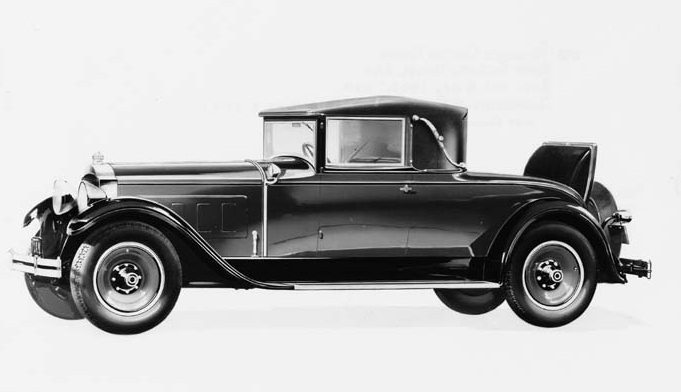
My mother bought our first family car in 1948. I say mother bought it, even though Mom would in fact never drive a car in all her 94 years, because she was the family controller, CFO, and treasurer. So, after I had pointed out ad nauseam that everyone owned a car but us, she authorized me to see what could be bought for a reasonable price, by which, I sensed, she was talking about $200 or less.
The car I found was owned by a man a few blocks away, and at $150 I thought that Mom would agree to buy it. She did, and within a week a car was sitting in our driveway – where, as far as I knew, no car had ever sat before.
It was a red 1929 Packard convertible, with a rumble seat. The body was in perfect condition, and the eight-cylinder engine ran passably. The leather seats (including the rumble seat) were in good shape, but the convertible top was ragged. One of the features was a lever under the dashboard which, if pulled once a day, would lubricate various parts under the hood. That was the theory, at least.
A fuzzy line separates the two automobile categories “old” and “antique.” Motor vehicle registries use arbitrary minimum ages in authorizing special antique plates, but collectors have their own ideas on the subject. In 1948, a 1929 Packard was not an antique; it was just an old car, just as a 1987 car would be today. In 1948 they were still making Packards, which were upscale cars, like Cadillacs. There was no way to know that the Packard automobile would disappear from the landscape a decade later and that old Packards would become prized by collectors. (Moral: Save everything.)
Since the car had been bought at my urging, I bore the responsibility for improving the appearance. First, I painted the entire body black, adding a thin red stripe along each side. It was an amazingly good paint job for a non-painter. (I had guessed, correctly, that you couldn’t go far wrong with black.) Then I arranged for a local garage to replace the worn top with new black canvas. When the facelift was complete, the Packard looked like a million dollars (which, if I had been smart enough to mothball it, is not far from what it might fetch today).
Our first family drive in the Packard was a day trip to Hampton Beach. Dad drove, Mom sat beside him, and my kid sister and I sat in the rumble seat, praying that it would not rain. (If it did, we would be only slightly wetter than Mom and Dad, since there were no windows, only snap-on side curtains.) This was long before the interstate era, and we drove up Route 1, through Ipswich and Rowley, up and down the long, steep hills. The ups were barely manageable by the car, its eight cylinders straining to haul almost two tons of steel up each grade, but we made it to New Hampshire, where the grown-ups took in a band concert while the children headed for the penny arcade. Then the Packard carried us home in style, and I felt that my campaign to persuade Mom to spring for a car was vindicated.
Dad used the car to commute to work in a town west of Boston, and one day, on Commonwealth Avenue in Newton, a fellow driving a Ford made a major error in judgment when he tried to make a quick left turn in front of my oncoming father. It was no contest. The Ford was destroyed (the driver unhurt), while the Packard hardly had its hair mussed, the only visible damage a crooked bumper. It was an unfortunate occurrence, but my Dad took a perverse pride in our car’s imitation of a Sherman tank.
Not long afterward, the Packard died on Dad, this time in a Newton residential neighborhood, and that was it for him. He left it by the side of the street, took the T home, and announced that, as far as he was concerned, the car could rot in Newton. Next day, my friend Dan and I made our way to the abandoned Packard, and I raised the hood to inspect the situation. (I knew nothing about automotive mechanics, but I thought this was the thing to do – sort of like getting hot water when a baby is being born.)
In no time at all, a man who lived in a nearby house was at my side, asking if he could help. (Even then, a 1929 Packard convertible was irresistible to car buffs.) He guessed that a gasket on the fuel filter was leaky, but he figured that he could make a replacement out of cardboard. He ran to his house and came back with cardboard and a pair of scissors. Then, using the old gasket as a template, he fashioned a new one. I got in the car, turned the key, and presto, the motor was purring.
One problem: I did not have a driver’s license. Neither did Dan. But I had occasionally been given the wheel on Sunday drives, and I felt sure I could navigate the dozen or so miles home to Dorchester. And I did, presenting my parents with a conundrum: Should they be furious at me for driving without a license, or should they be grateful to see their Packard back in the driveway? Gratitude won out, as I figured it would.
Shortly afterwards I got my license (renting a Plymouth for the test), and we turned the Packard in to buy a brown 1937 Hudson sedan, a fine car that carried me and Dan to college every day, reliably and comfortably. It even had a radio, a luxury the Packard lacked, But that Packard had class, more in fact than any of us recognized at the time. I sometimes wonder what happened to it. It could have wound up in a scrap heap, a crushed cube of steel. Or it could be the centerpiece of an antique auto collection, somewhere in California or Saudi Arabia. One thing’s sure: They don’t make them like that any more.
Thursday, November 09, 2006
Monarch of the Glen

In 1999, the BBC launched a weekly television series called “Monarch of the Glen,” based very loosely on some novels written by Compton MacKenzie. The series was wildly successful, not only in Britain, but on the European continent, in Australia and New Zealand, and, via BBC-America and PBS, in the United States. It ran for seven seasons, has been rerun since, and the BBC does a brisk business in DVDs. It has also spawned a cult of Monarch followers, who call themselves “boglies” because the series takes place at a Scottish estate called Glenbogle.
Two old pros anchor the series: Richard Briers plays Hector MacDonald, the Laird of Glenbogle, and Susan Hampshire plays his wife Molly. As the series begins, their son, Archie, is preparing to open an upscale restaurant in London when he hears that his father, Hector, has had an accident “in the loch.” Archie drops everything to catch the sleeper to Scotland and Glenbogle. There he finds his father just fine after his dunking, and Hector and Mollie seize the moment to inform Archie that, for tax reasons, they have made him the new laird of the 40,000-acre, near-bankrupt estate.
Archie wants none of this, but events conspire to keep him at Glenbogle, where he tries to right the sinking ship while romancing the local teacher, his old girlfriend up from London, and Glenbogle’s chief cook and housekeeper (shown with Archie, above). The acting is superb, the writing even better, and the scenery spectacular. (The fictional Glenbogle is actually a highland estate called Ardverikie, to which boglies make regular pilgrimages.)
What accounts for the extraordinary worldwide response to “Monarch of the Glen”? First, there is that writing, always wise and witty. Second, Briers and Hampshire are joined by a flock of fine young actors from the BBC’s seemingly limitless pool. Third, it is clean as a daisy – no steamy sex, no four-letter words, no violence. (But the series is not “Mary Poppins,” and most of it would be over the heads of small children.)
Seven seasons is an eternity in television, and actors must be written out of the story line when their contracts expire or when better opportunities call them away. (Richard Briers, after three seasons, left to spend more time with his grandchildren.) The writers coped with these comings and goings fairly well, but whenever a central character is dropped from the story, there is a palpable feeling of loss, which says something about the program’s hold on its audience.
The first five of the seven series are now available on DVDs, which are rentable from Netflix. Many boglies have bought DVDs of the final series from the UK, sometimes buying multi-region DVD players expressly for the purpose. You will also find a bustling trade in “Monarch of the Glen” DVDs on eBay.
This is a gem of a television series, and it will make you want to hop on the next flight to Scotland. I wholeheartedly recommend it.
Tuesday, November 07, 2006
Reflections of an ex-Teacher

Let’s state one thing up front: My first job, after I graduated from college, was as a high-school teacher. I loved the work, but I found my career elsewhere. My wife Jill was a kindergarten teacher for eight years, before and after we were married. We are both ex-teachers, then. We both think that teaching is a noble profession and that teachers deserve more respect in our society. Most of them deserve more money, too, but some of them do not, which brings me to my first point.
When, at age 22, I decided that I didn’t want to spend a lifetime in the teaching profession, my reasoning went something like this: I think I’m an excellent teacher, and I like the challenge of teaching, but 20 years from now, if I’m the best teacher in my school, my salary will be exactly the same as if I’m the worst teacher in the school. That proved to be a powerful disincentive. Teachers’ unions exist to protect the mediocre, not to reward excellence, and in their vocabulary “merit” is a dirty word. So I left teaching behind.
I won’t attempt to speak for Jill, but I believe that her complaint had much to do with the winds of change that swept the teaching establishment in the 60s, change driven by would-be educational revolutionaries, change we saw first-hand as we raised three children in public schools that served as laboratories for Harvard theoreticians. There was a period in the 60s and 70s during which the education of small children was secondary to the ambitions of the self-proclaimed pioneers and grant-seekers. Millions of children were educationally short-changed in that era.
Then came the era of political correctness, best described by an anecdote. Years ago, as a member of a town finance committee, I toured an elementary school one evening just before Christmas. I mentioned to our guide that I didn’t see any evidence of Christmastide – no crèche, no wreaths, no pictures of the infant Jesus. “Oh, no,” I was told, “we can’t have any of that in here; it wouldn’t be allowed.” Then I spotted, in the hallway, a large framed photo of Nelson Mandela. Mandela was a hero, Christ was not, at least not in that (Massachusetts) school system.
The web of political correctness now overspreads just about everything we do, but it is most suffocating in our schools. Public support comes with strings, we all know, and a minority of taxpayers has the power to drive the educational agenda. In Leningrad I once saw a church that had been turned into a roller skating rink and another turned into a museum by people whose mantra, like that of many Americans, was “separation of church and state.” Once you really separate church and state, the Russians discovered almost a century ago, the state holds all the cards.
Back to the schools. The “special education” budget in Massachusetts towns was an open invitation for parents to claim extra privileges for their children, and suddenly a disproportionately high percentage of all students were “special,” their status proved by an army of consultants that sprang up for just that purpose. New handicaps were invented (or rather, new names for old handicaps), each with its own lobby and its own charitable foundation. We undoubtedly had the same “disorders” in the 30s and 40s, but we never knew about them.
The foundations raise money, they create jobs, and they are unstoppable, because they represent “investments in our children.” How can any selectman, any budget director, any voter fail to support a program designed to help our children? And if you waver, there is a steamroller coming right at you: the teachers’ union, possibly the most powerful lobby in the country. Where I live, we spend well over $10,000 a year to educate each one of our children. It’s not enough. It’s never enough. If enrollment drops 10 percent, program needs will expand 12 percent. Count on it.
If you want to poke this hornets’ nest, ask, at your next opportunity, what percentage of your school department’s budget or personnel count is devoted to classroom teaching? I tried that once, and the school superintendent could not or would not answer. That’s because the percentage is usually embarrassingly low. If you persist, you will eventually be told that the explosion in the non-teaching budget is a byproduct of various federal or state mandates. Maybe so, but a few years ago I remember reading that the huge Chicago parochial school system was run by about a dozen administrators.
Teaching, as I said, is a noble profession. If I were running things, I would try to identify the really top teachers and give them six-figure salaries. I would replace those who were mailing it in. I would hire math teachers who knew math, whether or not they knew how to compose lesson plans. I would make sure that at least 90 cents of every education dollar went straight into the classroom. And this time of year, there would be, in the school cafeteria, a tall Christmas tree with an angel sitting on top.
Friday, November 03, 2006
Commercials

Considering the low quality of TV commercials these days, I have this vision of contemporary life at a big ad agency.
Creative Director: So you want to be a copywriter. Where did you go to school, and what was your major?
Applicant: I was majoring in phys ed at State, but I flunked out.
Creative Director: Do you do much reading?
Applicant: I look through People magazine every now and then. The pictures, mostly.
Creative Director: What qualifications do you have for a job in advertising?
Applicant: My uncle is a VP at your biggest client. He said I could get a job here.
Creative Director: Great! We’ll start you off writing TV commercials aimed for the teen-age, drop-out demographic.
We live in the age of inane commercials, in which desks and chairs disappear, cars fly over the highway, and cows parachute onto a football field. The guiding principle seems to be that if we give them enough computer graphics, maybe they won’t notice that the ads don’t make sense.
To be fair, a few commercials – one out of 20, maybe – are clever and witty. One of my favorites shows a mother telling a TV mobster that she’s going to block his program because it’s too violent for her kids, whereupon the hood offers to give her the watch of his last victim. (“I want you to have Vinnie’s watch, because you deserve it.”) No computer graphics, just a writer with a good sense of humor and a perfect group of actors.
And no one can complain about the commercials from big pharma, which include disclosures of the terrible things that can happen to you if you use their product. “Possible side effects,” the announcer tells us matter-of-factly, “may include nausea, shortness of breath, chest pains, dizzy spells, internal bleeding, irregular heart beat, or, in rare cases, death.” These are arguably the best commercials of them all, because they are truthful to a fault. (And if you take the pill and live, you will feel triumphant.) If brokerage firms were held to the same standards, the announcer would say, “Possible side effects may include loss of all your money, the break-up of your marriage, the loss of your job, and a nervous breakdown.”
Not all pharma companies are blameless, however. Scenes of elderly people gamboling through the fields like Julie Andrews, with the voice-over suggesting that you “ask your doctor if ---- is right for you,” are borderline deceptive. Then there are the faux-medical commercials, like the one showing a white-jacketed announcer, meant to look like a doctor, telling you that a certain brand of mattress will enhance every aspect of your life.
To say that the humor in today's commercials is sophomoric would be to insult sophomores everywhere. I try hard to give the benefit of the doubt to the young (make that immature) copywriters responsible for this rubbish, but it is no use. They should not be copywriters; they should be highway toll collectors or mail sorters or chicken pluckers. If they insist on writing humor, they could create material for some hard-up comic, like John Kerry. But they should not be writing TV network commercials for Fortune 500 companies.
The worst offenders are the fast food and beer producers (aiming at that teen-age, drop-out demographic) and, ironically, financial services firms (aiming at fools with money). Budweiser once produced some classy commercials, like the Clidesdales clopping home at Christmas, but today they are joining their competitors scraping the bottom of the keg. Other big spenders are the automobile makers, whose ads seem to be irresponsibly encouraging reckless driving, warding off lawsuits by cautioning that we are watching a professional driver on a closed course. Oh.
The prize for the dumbest commercial currently running goes to the brokerage firm that tries to make the doubtful point that investors are changing their behavior – by showing office workers behaving like wild monkeys when their boss isn’t looking. I don’t remember the name of the advertiser, which is just as well.
The Capital One commercials, obviously expensive, seize on one doubtful point: people will choose a credit card based on the chance to gain unrestricted air miles. I’m sure that Capital One has market research to support its campaign, but I’m skeptical. These days, most folks I know would rather not fly at all, period.
Lawyers’ commercials are both irritating and unprofessional. A Portland law firm shows us three grim-faced attorneys walking toward the camera, obviously ready to file suit against the cameraman. They try hard to look tough, but whenever I see them I think of the trio as Dewey, Cheatem, and Howe.
The lame commercials are especially annoying during sporting events. Baseball games come with a large supply of gaps for advertisers to fill – a gap every three outs, plus a gap when a team changes pitchers, and even gaps between pitches, if the pitcher is deliberate enough. It’s even worse in football, where commercials are stacked up until there is a break in the action, then unleashed in a nonstop stream of idiocy. An injured player, a time out, a call being reviewed in the replay booth – all these stoppages ring the cash register for the advertisers, or at least for their agencies.
The basic problem, I suspect, is that too little creative talent is chasing too many available minutes of TV time. The proliferation of cable channels hasn’t helped, providing an outlet for the worst of the lot: the home-made commercials for the local furniture stores and car dealers. These I can forgive, because they operate on tiny budgets. But the appalling quality of the network commercials, prepared by major corporations at obscene expense, is inexcusable. No wonder that so many eyeballs are fleeing to the Internet – as you so wisely have.
Subscribe to:
Posts (Atom)