Wednesday, April 10, 2013

Cloudstreet


It has been over 30 years since I first saw the Granada miniseries Brideshead Revisited, and ever since then I have considered it the finest drama ever produced for television. I still do. The writing (much of it lifted directly from Evelyn Waugh’s novel), the acting, the photography, the direction, the music were all, as the British would say, top-shelf, and I have never questioned my original assessment of it as the best.  There have been flashes of brilliance in other dramatic series, but, taken as a whole, nothing compares with Brideshead.  But I have just seen a six-part miniseries that comes very close.  And the chances are that you’ve never heard of it.

The series is called Cloudstreet, and the DVD is available, although it has yet to be seen on American TV.  The production is from Australia and is based on a much-acclaimed (in Australia) novel by Tim Winton.  It has nothing in common with Brideshead except the quality of the story and the wizardry of the casting and direction and acting.  It probably will not satisfy all tastes, but it certainly satisfied mine.

The story involves two families in Western Australia in the 40s and 50s.  They are the Lambs and the Pickles, both hit by the depression and by tragedy.  Sam Pickles has lost the fingers of one hand in an accident, and the Lambs’ youngest son has nearly drowned and is as a result retarded.  Sam Pickles inherits a large but ramshackle house near Perth and looks for a family of tenants to share in the upkeep. Enter the Lambs.  The spine of the story is the relationship of the two families as the years pass.  But it is most assuredly not a soap opera.  “It is a story about life,” says the book’s author, simply.

Promising as the story is, it is the artistry of the director (Matthew Saville) that produces the magic that we see unfold in the DVD. That plus the casting. The acting is absolutely flawless, and it is all the more striking to an American viewer because the Australian cast is unfamiliar.  There is not a weak link in the bunch. 

How can Australia, which has fewer people than Texas, produce such a beautifully crafted television drama?  Years ago, the country gave us A Town Like Alice, an excellent series based on a Nevil Shute novel, but that was 1981 (the same year that gave us Brideshead).  Maybe there were other great dramas from Down Under, and I just haven’t been paying attention, but I doubt it. But I certainly will be watching from now on, and I have marked Matthew Saville as a name to be reckoned with.

You are unlikely to see Cloudstreet on Masterpiece Theater.  The series has several sexually explicit scenes and some four-letter words, and the Aussies would probably not tolerate heavy-handing editing.  Too bad; such quality television deserves a large audience.

Saturday, March 23, 2013

The Falkland Islands


The  accession of Cardinal Bergoglio to the Papacy has turned the world’s attention to Argentina, and thus to the ongoing dispute between Argentina and Great Britain over the ownership of the Falkland Islands.  Adding to the turmoil, the population of the islands recently voted overwhelmingly to remain British. (The vote was 1514 to 3, of a total turnout of 92%.)  That doesn’t matter, huffed the President of Argentina, comparing the plebiscite to squatters voting to continue living in a building.  (Well, yes, but what if the squatters lived in the building for 160 years?)  Anyhow, most Argentinians seem to agree with their President; 59% in a recent poll thought the Falklanders should have no say in the matter.

The temperature seems to be rising. Most other South American nations agree with Argentina, though everyone agrees that the vote was free and fair.  Argentina holds strong cards, including the threat to close its ports to ships calling at the Falklands.  Apparently the Falklanders don’t take kindly to such threats, even in the face of growing isolation and financial hardship.

The Falklands are a pretty place. Jill and I visited the capital, Port Stanley, in 1998. The photo above was shot on that memorable visit. (The Economist calls the Falklands “the sparsely populated islands, which lack paved roads.” The writer has apparently never been to Port Stanley.)  The town was proudly British, with shops selling tea and woolen sweaters and tidy houses sporting flowered window boxes. Occasionally an RAF jet would shoot by, having taken off from the air base that serves as the Falkland’s principal link to far-off England.

In 1982, a war was fought between Great Britain and Argentina over the ownership of the islands. It was brief (two months), but there were over 2700 casualties, two-thirds from Argentina.  Could it happen again?  Before you answer, consider this: Could the U.S., still smarting from the cost of Iraq and Afghanistan, embark on a war with Iran or Syria?

Thursday, February 28, 2013

Rules of Civility


The novel is Amor Towle’s first, and it’s a most impressive debut.  Written in the first person, it’s a story told, mostly in flashback, by Katie Kontent.  As the novel  opens, Katie and her husband are touring an exhibition of photographs taken on the New York subway in the 1930s.  The subway riders wear faces of urban boredom, which is the point.  Katie thinks one of the faces is familiar, then she sees him again in another photograph.  Now she is sure: It is Tinker Grey.  Her husband confirms it, Katie’s memory takes over, and the novel is launched.  

This is a New York novel, with more than a hint of Scott Fitzgerald and the New York novels of Dawn Powell. Manhattan in the late 30s.  Most of the characters are well insulated from the Depression, privileged people with pieds-a-terre in Manhattan and big homes on Long Island.  Katie is a working girl, most definitely on the outer fringes of society, but she and her friend Eve parlay good looks and sharp wit to worm their way into the inner circle.  Tinker Grey is at the center of this circle, along with various friends that inhabit the social stratosphere.

The author is a literary stylist, and a damned good one.  A graduate of Yale and Stanford, he is a principal of a New York investment firm.  For a male writer to channel a female memoirist is no small trick, but Towles pulls it off convincingly. 

Katie is the kind of a girl that today’s television would build a sitcom around.  She has pithy one-liners galore, and she attracts not only men but women, who collide with her a little too often, given the population of 1938 Manhattan. (“Katie? Katie Kontent? Is that you?”)

The title refers to a list of 110 rules of civilized behavior, as drafted by a young George Washington, and printed in an appendix. (No. 65: Speak not injurious Words neither in Jest nor Earnest. Scoff at none although they give Occasion.)  The list of rules has relevance to the plot, but I should tell you no more.

Monday, February 18, 2013

The Vast AM and FM Wasteland


In this area, there used to be two FM stations that broadcast classical music:  the local “W-BACH," which serenaded me to sleep each night, and the NPR station, whose outlets were scattered around the State and which intermixed classical music with jazz and news and word games.  Now classical music is gone, gone, gone. You can find country music and Latino music and hard and soft rock.  You can find, on the AM and FM dials, political talk and sports talk and call-in talk, which is whatever idiotic subject Joe Sixpack wants to vent about. But you cannot find Beethoven or Mahler or Mozart. For that matter, you cannot even find Jerome Kern or Richard Rodgers or George Gershwin.

It is just as bad on the road, for the high-fidelity radio in my car carries nothing but low-fidelity content.   So I depend on CDs for good music.  At night, an iHome and an iPod stocked with show tunes and classical music soothes me to sleep.  So all is well, except for one thing:  If the roughly 40 commercial radio stations within range deliver nothing but inane chatter and rock, who needs them? Fewer and fewer of us, I’ll bet, as more and more of us listen to CDs and iPods.  The radio is useful for news and weather and sports, but you need only two or three stations for that, not 40.  As for music, it’s all the same, a waste of precious bandwidth.

Right now, as I am typing this, I am listening to Jean-Yves Thibaudet playing Gershwin’s Concerto in F with the New York Philharmonic.  The concert was broadcast New Year’s Eve, and I recorded it on DVD.  It’s gorgeous music, and there are no commercials. If W-BACH were still in business, I’d probably have it playing. But it’s gone. The same fate awaits most of the stations on the AM and FM bands.

Monday, January 07, 2013

Two Hugo Movies


I saw two Hugo movies in the last few days.  One was Les Miserables, the musical based on Victor Hugo’s classic novel. The other was Martin Scorsese’s  Hugo, a fantasy based on Brian Selznick’s children’s book.  Both were terrific.

Les Miserables

Les Miserables, popularly called Les Miz, is the most successful musical-theater production of all time, and its transfer to the big screen has been eagerly awaited.  The wait was worth it.   Hugh Jackman, as the hero Jean Valjean, is simply marvelous.  The Australian is of course no stranger to the musical theater, but his past successes do not prepare you for his performance in Les Miz. He is a certain contender (if there is any justice) for a best actor Oscar. 

One of the best roles the musical theater has to offer is that of Jean Valjean’s stalker, the policeman Javert, and once again Hollywood chose box-office appeal rather than talent. Not that Russell Crowe can’t act; he is in fact an excellent actor, but he is no singer, so Javert’s dramatic soliloquy Stars does not get the show-stopping treatment it deserves.  It is an infuriating miss, reminiscent of Hollywood’s choice of Rosalind Russell over Ethel Merman in Gypsy or its snub of Julie Andrews in My Fair Lady.

Anne Hathaway, not known as a singer, handles her songs very well, and her acting has earned her widespread praise. Amanda Seyfried plays Cosette rather woodenly.  Speaking of wood, Helena Bonham Carter plays Madame Thenardier.  Her husband, the “master of the house,” is played adequately by Sacha Baron Cohen.

The real star, aside from Hugh Jackman, is the material.  The book is the most moving piece of fiction I have ever read, and the score is stunning. (The same composer gave us Miss Saigon, whose score is almost as good.)  Bottom line: Despite the shortcomings, this motion picture is well worth seeing.

Hugo

In my opinion, Hugo is Martin Scrosese’s masterpiece.   This is the tale of a young boy (Hugo) who tends the big clock in a Paris railroad station, after the deaths of his father, a mechanical whiz, and his uncle, a drunkard.  Hugo lives in the dark recesses of the station,  where he must avoid the clutches of the gendarme (Sacha Baron Cohen),  who sweeps boys like Hugo into the orphanage.  Hugo, who has inherited his father’s love of machinery, works on an automaton left by his father – an automaton, Hugo believes, which holds an important message.

In the station is a toy shop, whose owner is a misanthrope (Ben Kingsley) who, it turns out, once was a movie pioneer. There are thus two story threads, one involving the boy and his automaton, one involving the earliest days of movies, and the two threads merge in a conclusion that is wholly satisfying.  The movie is, in a word, wonderful. The recreation of 1930’s Paris is staggeringly beautiful. (One can see why the film cost $170 million to produce.) The acting is topnotch, as are the cinematography, the music, and, most of all, the charming story.  A plus: It is a film that families can enjoy together. Now, how many Martin Scorsese movies can you say that about?

Thursday, December 27, 2012

Bloomer Girl, Dearest Enemy


Santa, who knows my passions, gave me two videos that I cherish.  One is the Rodgers & Hart musical Dearest Enemy, the other is Bloomer Girl, written by Harold Arlen and E.Y. Harburg.  Both shows were television productions, in 1955 and 1956.  They are black and white videos, and the technical quality is, well, primitive. But the material! Let me tell you about them.

Both are set against the definitive wars of our country. The American Revolution supplies the plot for Dearest Enemy, which opened in 1925, just months after the Rodgers & Hart breakthrough review, The Garrick Gaieties.  Dearest Enemy was thus the first book musical written by the pair of youngsters. (Rodgers was only 23.) The story line: General Howe and his contingent of British soldiers are bent on capturing George Washington, who is planning to rendezvous with one of his officers. The British are staying at the New York inn of Mrs. Murray, and Mrs. Murray and the other women at the inn contrive to detain the British long enough to spoil their plan. You can fill in the blanks. The romantic leads are played by Robert Sterling (a British officer) and Anne Jeffreys (one of the American contrivers).  The comic relief is furnished by two old pros, Cyril Ritchard as General Howe and Cornelia Otis Skinner as Mrs. Murray. Only one song had lasting popularity: Here in My Arms.  Here’s a Kiss gave a hint of the melodic treasures that Rodgers would give us over the decades to come, and Cheerio and Sweet Peter (Stuyvesant) were good  novelty songs. The show was telecast (live, of course) on November 26, 1955.  The credits include co-scripter Neil Simon and producer Max Liebman, best remembered today (by those old enough) as the creator of Your Show of Shows.

The other video, Bloomer Girl, is one of the great musicals of the 40s.  Composer Harold Arlen and lyricist “Yip” Harburg had teamed up five years earlier to give the world the score for The Wizard of Oz, and the two outdid themselves in Bloomer Girl, with one blockbuster song after another, including Evelina, The Eagle and Me, Right as the Rain, When the Boys Come Home, and Sunday at Cicero Falls (with the memorable line “virtue is its own revenge”).  The television cast is top-drawer, headed by Barbara Cook (pre-Marian the Librarian, pre-Cunegonde), with Keith Andes, Carmen Mathews, and Paul Ford providing strong support.  Agnes DeMille  staged the dances, and four of the dancers were in the original cast in 1944. (The television production was aired on May 28, 1956.) The title refers to the women’s campaign to replace hoop skirts with bloomers, but the weightier theme is the country’s schism over slavery. Harburg, always an ardent liberal, wrote one of his best lyrics for The Eagle and Me. (“What makes the gopher leave its hole, trembling with fear and fright?  Maybe the gopher’s got a soul, wanting to see the light…”)  This is a more serious play than Dearest Enemy, but it is still a musical comedy.  There is a war in the wings in both plays, but not a drop of blood is spilled in either.

Any lover of musicals will value the chance to see these telecasts – the only surviving record of either play. It is hard to understand how Arthur Freed let Bloomer Girl escape the MGM treatment.

When watching these grainy kinescopes, it is easy to cluck at the their technical shortcomings. But wait.  Viewers in 1955 and 1956 may not have had Blue Ray or Surround Sound, but they could watch good studio productions of important musicals. What do we have in their place?  Two and a Half Men?  CSI?  People 50 years ago could watch good variety shows, with Jackie Gleason, Sid Caesar, Carol Burnett.  They had The Bell Telephone Hour, Playhouse 90, Studio One. We have big, flat screens – and very little of quality on them.

Monday, December 17, 2012

Newtown, CT


The simplest course for President Obama is to make some nice speeches – as his predecessors have in similar circumstances – and hope that other problems take people’s minds off Newtown, Connecticut.  There is no shortage of other problems.  In a pre-election blog we wrote that, given the state of the country and the world, the winner of the election might be the real loser.  Tonight, as he ponders the wisdom of taking on the NRA, he may wish Romney had won.

But that would be wrong.  He could be the right man in the presidency at the right time.  For if the massacre of 20 little children can’t move this nation to end its gun culture, then nothing can.  If Obama, one of our most gifted orators, can’t move the public to demand tough federal gun-control laws, then no one can.

 The NRA is politically very powerful, with many Congressional allies.  For any politician, a cardinal rule of self-preservation is: Don’t upset the NRA.  Yet the NRA has 4.3 million members. That means that there are about 296 million people in the United States who are not members of the NRA.  How many of those 296 million believe that this nation, more than any other developed country, has tolerated for far too long an obsession with guns – not the kind one hunts with, but the kind that is manufactured for one purpose and one purpose only:  to kill other human beings, as many as possible in the shortest possible time?

In the eighteenth century this country’s founders crafted the second amendment as a counterweight to an oppressive government, and many believe that freedom to bear arms is still our best defense against tyranny.  But that’s nonsense. We live in an age of drones and wiretaps and security cameras and Navy Seals and the CIA.  Does anyone really think that a stash of firearms will defend him and his family against a rogue government? 

It is time to outlaw the private possession of automatic weapons and to require a background check before issuance of a gun permit.  If the NRA is smart, they will take the lead in the movement to enact sensible gun laws.  But if they do not, they will incur the public scorn they will deserve.  It is all up to Barack Obama.  In the weeks ahead, we are going to find out what kind of a leader we have elected.

Saturday, December 01, 2012

Old Movies Recently Watched


Avanti!

One of my all-time favorites, this was Billy Wilder’s best movie, much better than Some Like it Hot. If you haven’t seen it, you’re in for a treat.  A wonderful plot for an off-beat romantic comedy, starring Jack Lemmon and Juliet Mills, with the incomparable Clive Revill and a host of wonderful Italian character actors lending support.  It was filmed on the Italian island of Ischia and released in 1972.  As the movie opens, executive Wendell Armbruster Jr. is boarding an Al Italia flight for Italy to claim the body of his father and return it to Baltimore for a huge funeral, to be attended by everybody who is anybody in 1972, including Henry Kissinger and Billy Graham. To tell you more would be criminal.  By all means see it.

Pride and Prejudice

The 1940 film starred Green Garson as Elizabeth Bennett and Laurence Olivier as Darcy. Squeezing the story into two hours required some compromises, which limit the impact of this one and the 2005 film starring Kiera Knightly.  Still, if you have only two hours, the 1940 black-and-white film is the better movie.  Most Jane Austen aficionados (like me) prefer the 1995 miniseries starring Colin Firth and Jennifer Ehle.  A special delight is David Bamber’s portrayal of Mr. Collins. But my favorite production of an Austen novel is the 2008 miniseries

Sense and Sensibility

which is outstanding.  Hattie Morahan (sense) gives what may be the truest depiction of an Austen heroine that I’ve ever seen, and Charity Wakefield is almost as good as Marianne, her sister (sensibility). A bonus, for Downton Abbey fans, is the opportunity to see Dan Stevens before he was Matthew Crawley.  This is a first-class production, with good writing (Andrew Davies), excellent acting, and beautiful scenery.  Best of all, it ties everything up in three one-hour episodes.

Woman Times Seven

Speaking of Downton Abbey, which adds Shirley MacLain to the cast in Season 3, those who want to see Shirley as she was in 1967 might sample this series of seven short stories, all starring Ms MacLain. Only two of the seven are worth your time – the first, co-starring Peter Sellers, and one other, featuring MacLain as a Parisian grande dame who is infuriated to find that the dress she plans to wear to the Paris Opera has been copied by a rival. The entire movie was filmed in Paris. A much better look at la MacLain in her youth is The Apartment, filmed in 1960.

Romantics Anonymous
Death at a Funeral

By no means a memorable movie, Romantics Anonymous is a harmless way to spend an hour and a half. It is a French romantic comedy about two socially inept people, one of whom, the lady, works at a failing chocolate factory run by a man even more socially awkward than the lady.  Death at a Funeral is a British farce starring Matthew Macfadyen. It has some hilarious moments, but not enough of them to warrant my recommendation.

Bottom line: See Avanti! and the 2008 miniseries Sense and Sensibility.

Friday, November 30, 2012

Millionaires and Billionaires

 
President Obama wants to raise taxes on the “millionaires and billionaires” he railed against in his campaign.  So he targets those people who earn more than $200,000 a year in the  income-tax revamp he proposes, thereby conflating those “fat cats” with the millionaires and billionaires of his wrath.  A lot of people in New York City and Los Angeles (ironically, two of the bluest cities in America) must be wondering what their idol is smoking.

If you are a single filer in New York who is earning $200,000 a year, you probably don’t feel like a fat cat.  After paying State, City, and Federal taxes, there’s not much left.  $200,000 may be a comfortable wage in Wyoming, but it almost qualifies you for food stamps in Manhattan.  (Hey, here’s an idea that some legislators could embrace: Make income tax rates depend on where you live.)

There’s another problem:  Once inflation starts to roll, $200,000 will not seem like so much. In fact, the median income could quickly rise to six figures, and the tax meant to nail fat cats (like the Alternative Minimum Tax) will start hitting Joe Six-Pack.

Attempts to avoid the “fiscal cliff” may force Obama to swallow a higher break point – say $500,000.  New York legislators, worried that legions of executives will flee the Big Apple, may join Republicans in pleading the case for the $200,000 billionaires.  After all, New York is Obama country.  In Wyoming, he got only 28 percent of the vote.

Monday, November 12, 2012

The Fiscal Cliff

 
Today’s buzz is that President Obama and Republican leaders are huddling to cut a deal that will avoid “the fiscal cliff,” the very cliff that members of Congress built a few years ago to create an incentive to do the right thing.  My own view is that the dreaded fiscal cliff sounds like a reasonable palliative, an austerity program to match that being urged on certain European countries. But my point here is a quite different threat.

When and if Obama and the Congress make a deal, a lot of people will know about it before you and I do, and those people “inside the Beltway” will have the opportunity to make a fortune by buying stocks or options, because the announcement of the deal will almost certainly cause an enormous spike in the market.  No Congressman will actually call his or her broker, of course; that would be foolish. Spouses or other relatives will be the buyers. And there will be no whistle-blowers. Insider trading is something hedge-fund managers do, not politicians.

Of course, it is possible that no member of Congress or White House staffer ever uses advance knowledge of a news bombshell for his or her financial advantage.  It is also possible that the moon is made of green cheese.  But when we expand our view to include the staffers at the regulatory agencies and other government workers in a position to know market-moving information early, we have to conclude that this is the biggest story that never gets told – possibly because investigative journalists are in on the take.

Wonder why so many people spend so much money to keep their seats in Congress, or why so many live a life more comfortable than their salary would seem to justify? (That salary, for the House and Senate leaders, incidentally, tops out at $193,400 – just below the $200,000 single-payer mark that Obama targets for a tax increase.)  The answer: Washington is a money machine, whether you’re a Democrat or Republican.

Oh yes – what if the President and Congress fail to make a deal?  When that news breaks, the markets will dive.  Anyone with advance knowledge of that news can make money selling short.

Sunday, October 14, 2012

November 7th


On November 7th, the election will be over, and, barring some unexpected legal problem, we will know who won the presidency.  Half the country will be jubilant, half will be disappointed.  But no crowds will be rioting in the streets, as in other countries.  If the Republican wins, the transition in Washington will be peaceful, and President Obama will call President-elect Romney and wish him well. If the Democrat wins, Romney will do the same.  There is a message there, for other countries.

But the President, whoever he is, may soon wish he lost.  The problems the country faces are arguably the most intractable most of its citizens have ever experienced.  The national debt is over 16 trillion dollars, and it is growing with every tick of the second hand. (See USDebtClock.org.) Household debt is larger than disposable income. Student debt is approaching 1 trillion dollars. Our industrial production is headed south. Pension obligations are impossible to meet.  The problem is most acute in the public sector, but even in the private sector there is big trouble brewing. General Mills, for instance, has an unrealistic 9.5% target for its investments, and the median expected rate of return for S&P500 companies is 7.8%.  How many investors are making 7.8% these days? Hard-up pensioners and the unemployed are going to demand increased services, except that we can’t afford the services we’re already providing.

So the economic picture is horrendous.  The international picture is as bad.  In our efforts to export our values, we have managed to create millions of enemies over the past decade.  Some of them lost brothers or parents or children in Iraq and Afghanistan, and they have long memories, and they blame us.  The president also has to deal with a Eurozone that is falling apart and with Asian countries that have quarrels with China and expect us to support them militarily.  Israel is lobbying for us to attack Iran.  “Us” is the American taxpayer, who already is deep in debt.

Why does anyone want to be president anyway?  To fly around on Air Force One?  To give the State of the Union address? To enjoy a comfortable retirement, writing books and being protected by the Secret Service? But Barack Obama already has that.  Besides, whatever bad things happen (and you can be sure they will), he will get blamed.  I am sure that George Bush thought he was doing the right thing going to war in Iraq and Afghanistan, but most people today believe he orchestrated the worst foreign-policy blunder in modern history.  Given the world situation, it is possible that one of the two men now running for president may take the title from him.

On November 7th, the real winner may be the man who lost the election.

Saturday, October 13, 2012

October's Bright Blue Weather


October is, in my opinion, the most beautiful month of all in Maine.  Clear skies, colored foliage, lonely beaches, cool temperatures, formations of birds headed south – what more could a person want?  To top it off, television offers baseball playoffs and professional football.

Many of the neighbors are fleeing to warmer climes, and the point is steeped in deathly silence at night.  One can’t question their judgment; January is only 10 weeks away, and January can be bitter cold, with cutting winds and blinding snowstorms that make you wish you too were in Florida.

Most of the people who own properties on the Point are senior citizens, and old age, as a friend keeps reminding me, “isn’t for sissies.”  So the EMTs at KEMS (the Kennebunkport Emergency Medical Services) know the neighborhood well.  Some people, looking ahead, are selling their homes, and I have never seen so many choice houses (five) on the market around the Point. At the same time, several new homes have been built recently, some of them replacing tear-downs.  The new construction has certainly been keeping the local tradesmen busy; it is not uncommon to see 15 or more panel trucks parked on the street near one of the projects, month after month.

Most of the boats in the bay and in the river have been hauled, but on these crisp days one can still see large sailboats on the horizon, making for Cape Porpoise or down east.  You don’t see many lobster boats, probably because the lobstermen have been discouraged by low prices.

The other day I saw a dead seal pup on the beach. I called the authorities, thinking they would come to investigate, but the next day the seal was still there, a seagull pecking at it gingerly.

October also means things have to be done:  Time to wash and store the summer clothes and unpack the sweatshirts and flannel pajamas and sweaters and heavy shirts.  Time to change the sheets on the bed – off with the cotton, on with the flannel. Time to put the down comforter into its duvet, a tricky job.  Time for storm windows and sliders, time to store the deck furniture, time to store hoses and unstore snow shovels and blower.  So much to do, but somehow the chores seem simple when the weather is so inviting.

Friday, October 12, 2012

The Vice-Presidential Debate


Not that the vice-presidential debate matters a whole lot, but I thought Biden won by a nose.   

The problems for Paul Ryan: (1) He was oversold as a bright young financial whiz who would thrash Biden on economic matters. He is bright, but not that bright. (2) He had a tough hand to play. It’s easy to sell the notion that we can solve our economic problems by simply taxing the rich, that no one else has to worry, not the old, the sick, your grandmother, veterans, college students, etc.  Few voters want to hear someone try to sell castor oil. (3) Despite smiling (some would say snickering) too much, Biden was the more aggressive debater, seizing every chance to filibuster.  (4) The first 20 minutes of the debate was given to foreign policy, which played into Biden’s strength.  No matter how he tried to wiggle, Ryan sounded as if he wanted war with Iran, the sooner the better.  At 9:23 PM, the moderator switched the topic to the economy, which is presumably Paul Ryan’s strong suit.  But in a segment that ostensibly was on the economy, the subject somehow quickly returned to foreign policy:  Afghanistan, Syria, and back to Iran.  Again Paul Ryan showed the hawkish side of the Republican’s plea for a “more robust” foreign policy, attacking the very idea of apologizing for anything, even things that seem to demand a presidential apology.  It doesn’t seem to occur to some people that an apology can be seen as a sign of moral strength.

The final few minutes of the debate were spent on the candidates’ Catholicism, specifically on their positions on abortion. This segment was a draw. That is, no minds were changed. People who were pro-life are still pro-life; those who were pro-choice are still pro-choice.

It is safe to say that few if any votes were won or lost by last night’s debate. If you chose to watch the Yankees – Orioles baseball game, you didn’t miss anything important.


Monday, October 08, 2012

The Trip Wire

The House Intelligence Committee today recommended that the U.S. government not do business with two Chinese firms, Huawei and ZTE, and it urged U.S. companies not to buy their equipment. The Committee alleged that the two firms pose a security threat to this country. This could be the trip wire that sets off a trade war, and it deserves more attention than it is getting.

To begin with, Hauwei and ZTE are both world-class companies, with operations in the U.S. and over 100 other countries. Huawei is the world's second-largest maker of telecommunications equipment and a major customer of dozens of U.S. firms. ZTE makes cell phones and related products for AT&T, Sprint, Verizon, and T-Mobile, among others. The linkages are so tight between these firms and their U.S. suppliers and customers that it would be easy for Huawei and ZTE to retaliate for the blackballing.

The House panel charges that the two Chinese firms are so heavily dominated by the Chinese government that they cannot be trusted with critical elements of the U.S. telecommunications infrastructure.  Most of the evidence in being withheld on security grounds, but the allegations are plausible. In most advanced countries, the governments and their telecom companies are in bed together. U.S. telecommunications companies are known to collaborate with the government in wiretapping, and our security agencies are not likely to welcome outsiders to the party.

One complication is that thousands of U.S. jobs are at risk. Many capital-equipment makers count Hauwei and ZTE as customers. ZTE recently announced a $2 billion expansion of its U.K. operation, and Prime Minister Cameron rolled out the red carpet, touting the boost to the U.K economy. Huawei and ZTE can offer the kinds of jobs that most countries want, and if the U.S. pressures Cameron to call off the deal with ZTE,  some other country would welcome them with open arms.

Cyberwarfare and protection of intellectual property are sensitive issues, and they certainly make technology trade with Chinese firms difficult. But igniting a trade war is not the answer. The topic should be at the top of the agenda in any bilateral trade negotiation between the U.S. and China. Another complication right now is presidential politics. I am sure the two campaign teams are hard at work today, each trying to position itself as "tougher on China" than its opponent.

But the possible consequences of today's announcement are serious.  Unfortunately, they also include a nightmare scenario.

Saturday, October 06, 2012

Winners and Losers


Winner: Romney. I expected that, in a debate with the President, Mitt Romney would sound like a blithering idiot. Wrong. Mitt was energetic, agreeable, smart. It was the Mitt Romney the Republicans kept telling us we would eventually see. The President, a master orator who shines with a scripted speech and a teleprompter, was so-so but a pale shadow of the Obama we saw at Grant Park in 2008. The only question is whether "the real Romney" emerged too late in the game. I am still in the undecided column, waiting to hear the candidates discuss foreign policy - not a major issue for most voters, but a big issue for me, because after Vietnam, Iraq, and Afghanistan, I think another military crusade would destroy what's left of our economy and our credibility among the 95 percent of the world's population who don't live in the U.S.A..

Loser: Bobby Valentine. He should have been fired the day after he publicly questioned the commitment of Kevin Youklis (of all people). In fact, from the outset he was the wrong man for the job. There's enough blame to go around, since the front office made several questionable trades.  The 2012 season left a bad taste with Red Sox nation, and next year you may see a rarity at Fenway Park: thousands of empty seats.  

Winner; Matt Ryan. Here's the setup: Atlanta is trailing, 28-27, with less than a minute left to play and Atlanta on its own 1-yard line. Hopeless? No. Quarterback Ryan heaves a long pass, which is completed, and the Falcons kick a field goal to win the game. It was the third last-minute comeback of the young season for Ryan and the Falcons.

Winner: Steve Martin. His new 3-DVD set, "Steve Martin: The Television Stuff," is a fine collection of Martin's early stand-up work, before he decided to quit comedy-club gigs and TV specials in favor of the movies. The routines are not all choice; he is sometimes too crude for my taste, but the best of the humor is really hilarious, and he displays more talent than any one person should be allowed to have. He is a virtuoso on the banjo. He juggles. He is a magician. He tap dances (creditably) with Gregory Hines. And of course he is a master of visual comedy, especially in his "wild and crazy guy" skits. Accompanying the routines is an interesting interview with Martin, who is now in his late 60's. (Where did the years go?)

Loser: Hewlett-Packard. I am sad to see H-P falling into the scrap heap of American business because, although I spent a considerable part of my career competing against the folks in Palo Alto, I always respected H-P, and I regarded them as a class act. But the former titan of the test world has now become an also-ran of the digital world. What happened? For openers, H-P chose to look outside the company for their last four CEOs, including the current leader, Meg Whitman. What does it tell you when a company considers none of its 100,000-plus employees presidential material? Bill Hewlett and Dave Packard would have been ashamed.


Monday, September 17, 2012

The Death of Advertising

For the past century, we have been beneficiaries of the advertising model for financing the delivery of news and entertainment. We buy newspapers and magazines for far less than it costs to produce them, because of the subsidy of advertisers. and we listen to the radio and watch television “free,” because advertisers pay for the privilege of slipping in a commercial every few minutes.


The system is breaking down. Newspapers are dying everywhere. The New Orleans Times-Picayune, a once-proud old paper, has decided that it can no longer afford daily publication. Most newspapers are running deeply in the red, and magazines, even hallowed journals like Time and Newsweek, are wafer-thin. The old Business Week, a once influential magazine under McGraw-Hill, is now called Bloomberg Business Week, and rigor mortis is obviously setting in.


Radio, until recently supported by drive-time advertising, now must compete with all sorts of mobile gadgets, including phones that let you talk hands-free to your wife or secretary through your car radio – or what was your car radio till you found a better use for it. On a 100-mile drive today, I listened to what used to be a source of good music. But today the station was playing endless help-wanted commercials for – people to sell air time on their station!


Most radio stations deserve to become extinct. Here in Kennebunkport, the one classical music station recently changed hands – and format. Now it plays music that is indistinguishable from the music every other station plays. It’s bad enough losing Beethoven and Stravinsky; now there is no place on the dial for Kern or Rodgers or Berlin or Porter or Gershwin. So stations will all compete for the vanishing teen-age dollar, and one by one they will all give up, until all is news and weather and traffic reports.


But, you may say, the TV channels are full of political ads, presumably at premium rates. But how many of these ads will you see in December or next year? You may also note that Google, Facebook, and other social media are raking in tons of money and that the advertising model isn’t dead; it has just changed hands. I wouldn’t be too sure. General Motors has expressed disappointment over returns from Facebook, and everybody I know (a small sample, I grant you) claims never to look at the ads on their iPad screens.


Humans still have only two eyes and one brain, and there are still only 24 hours in a day, minus time for working, sleeping, and eating. Shopping? You know what you want, you access it on Amazon or eBay, and you buy it. Click, click, and you’re done. Browsing is something you do on your computer, never at a store.


Some day people will watch reruns of Mad Men for their historical value. Yes, son, there were advertising people who made big money thinking up slogans and catchy jingles. We called their advertising “commercials,” and advertisers paid handsomely for the space or air time, because they wanted to reach millions of viewers or listeners or readers.


All that, of course, was before the Internet.


Tuesday, September 11, 2012

The Messages


From: President Obama

To: CEOs of Fortune 500 companies, all bankers, insurance providers, and millionaires and billionaires


I don’t like you. You make far too much money, and you got it by off-shoring jobs, by paying obscene amounts of money to lobbyists, by overcharging customers for your products, and by cheating. I can’t say this in public, because I need your money, but you know this is how I feel. When I win this election (and I will, because there aren’t enough of you to stop me), it will be payback time. I will go after the one percent of you who control too much of this country’s wealth. Now, some may argue that there will always be a top one percent, but at least they will be good people, unlike you and your ilk.


From: Mitt Romney

To: the leaders of Russia and China


I don’t like you. Your governments are riddled with corruption. You throw innocent protesters in jail without a trial. You brazenly conduct military exercises in Asia and excuse them on the flimsy argument that this is where you live. You (Russia) are our most significant geopolitical foe, and you (China) are a currency manipulator. When I win the election (and I will, because most Americans want a muscular foreign policy), on my first day in office I will brand China a currency manipulator. I will also encircle all of Asia with our aircraft carriers, and see how you like that.


Commentary


President Obama’s message may play well in Venezuela or even in Sweden, but, like it or not, ours is a (relatively) capitalistic economy, and a president who believes that business leaders are the enemy may get elected, but he will never succeed in developing a prosperous economy. Businesses need cheerleaders in Washington, not hecklers. Obama bundles his heckling in soaring oratory, and he may well be sincere in his missionary zeal, but if he is, those who believe that a victorious Obama will pivot to the center may be in for a rude surprise.


As for Romney, Henry Kissinger’s philosophy of realpolitik says that in a tri-polar world, you never want to be one against two. Thus Nixon’s opening to China. So today, you should not needlessly provoke both Russia and China. Today’s Times has an interesting article (subhead: A Nation Rich in Land Strengthens Its Ties To One Rich in People) about the forces that unite these two Asian superpowers. Romney’s bellicose rants and his alliance with hawks like Dan Senor and John Bolton may pick up some yahoo votes, but they may foreshadow dangerous times should Romney and his warriors control Washington.

Sunday, August 26, 2012

Urgently Needed: One Great Speech

This week, Mitt Romney will have one last chance to connect with the American public. To this point, his personality is a blank sheet to most voters. To those who have been paying attention, he is wooden and aloof. Friends say that he's really a great guy, but that's not how he comes across, and in politics, impressions are everything.

What's more, his opponent is one of the best orators the White House has ever seen, and he has in Jon Favreau a very talented speech-writer. You can count on Barack Obama lighting up the stage in Charlotte, oozing common sense and clipping his g's ("payin" rather than "paying" a little more in taxes) to sound like just plain folks. It is a given that Obama's acceptance speech will be dynamite. So this week, for Mitt Romney, is High Noon, and he is Gary Cooper.

I don't know who Mitt Romney's speech-writer is, or even if he has one. But the evidence to date is not good. If I were writing his speech - and I have written dozens of speeches - I would start by confessing that my opponent is a master of oratory, then segue into "but if oratory were the answer, we'd have millions of new jobs today." I would in short give the devil his due, acknowledging that he is a decent man and probably a great drinking buddy. For inspiration, I would reread the speech Shakespeare gave to Marc Antony in Julius Caesar: "for Brutus is an honorable man; so are they all, all honorable men."

There is no shortage of material for a barn-burning speech. The headlines are full of grim economic statistics, But they must be packaged artfully. Just reciting statistics will not energize viewers, but just put them to sleep.

If Mitt Romney blows it this week, the election is over. There will be other speeches to give, but no one will be listening.

Tuesday, August 14, 2012

Paul Ryan

In the presidential race, count me as still undecided. But Romney's choice of a running mate has moved the needle in his direction. Paul Ryan is a thoughtful congressman who is young enough to have a brilliant future in politics. Assuming that the Republicans lose this election, you will probably see him at the top of the ticket next time around. The pundits have weighed in on Ryan. The New York Times was predictably hysterical in opposition, but I thought the most intelligent appraisal of Ryan was in today's Financial Times, under the byline of Christopher Caldwell. I couldn't have said it better myself, so I will just quote his last paragraph.

"The dynamic of modern liberal democracies is to grow. It is hard to put a welfare state into reverse without ripping the whole gear-works apart. Mr. Ryan is right that the US system of benefits is unsustainable. He must now win that argument against Mr. Obama. If he does, the Republicans will deserve to win. If he doesn't, they won't. Either way, the US election has suddenly turned into exactly what it should be: a decision about which of the two parties that colluded to get Americans into such a fiscal mess can best be trusted to get them out."

To that excellent precis I will add only this: Paul Ryan will tell the American electorate that the time has come to take some castor oil. Many, maybe most Americans won't like that message, and the Republicans may lose the election. President Obama will have a cheerier message: Just raise taxes on "millionaires and billionaires" and everything will be all right. But one way or another, we are all going to swallow castor oil - no matter who is elected.

Thursday, August 02, 2012

Republcans Choose a Weak Candidate - Again

The more I read about Mitt Romney, the less likely I am to vote for him. The latest piece is a profile of Dan Senor, his foreign-policy guru, who is another neocon in the mold of Richard Perle, Douglas Feith, and the other neocons who orchestrated the Iraq invasion. Under Senor's influence, Romney is starting to channel Dick Cheney, appearing to favor pushing Israel and Iran to the point where war is the only option left. Doesn't he know that this country is tired of wars fought, not to defend our shores, but to flex our power?

Some candidates win because their opponents are weak. In 2008, Obama won because the Republicans chose a weak candidate, John McCain, who then doubled down by choosing a totally unqualified running mate. George H.W. Bush won because his opponent (Michael Dukakis) was weak. Mitt Romney won the governorship of Massachusetts, not because he was a born politician, but because his opponent was Shannon O'Brien. (Who?)

Romney could still save his candidacy by throwing a Hail Mary in his choice of running mate, but at this point his chances look bleak. Who would have been better? Not Gingrich or Trump, certainly. But Pawlenty or Daniels would have had broad appeal. (My top choice, for the past several elections, was Colin Powell, but his time has passed, alas.)

I still count myself in the 8 or 9 percent of voters who are undecided. Romney and his circle are too hawkish. Obama is too sympathetic to statist rather than free-market solutions. I did not vote for president in 2008, and I may wind up passing this time, too. (I will vote in the other races, though.)

The two-party system, which has served us well for so long, is starting to look very tired.

Sunday, July 29, 2012

The China Syndrome


The public's resentment about China is palpable, especially in the heat of a presidential campaign. Candidate Romney promises that his first act upon becoming president will be to brand China a currency manipulator, setting in motion a list of retaliatory measures. President Obama attacks an opponent who, he says, favors outsourcing jobs to China. The race, it seems hinges on who can sound more hawkish on China and Iran. The hawks never ask what happens if relations with China escalate to the point where armed conflict is triggered. The lesson of Vietnam and Iraq and Afghanistan is forgotten: It is easy to start a war, tough to end one.

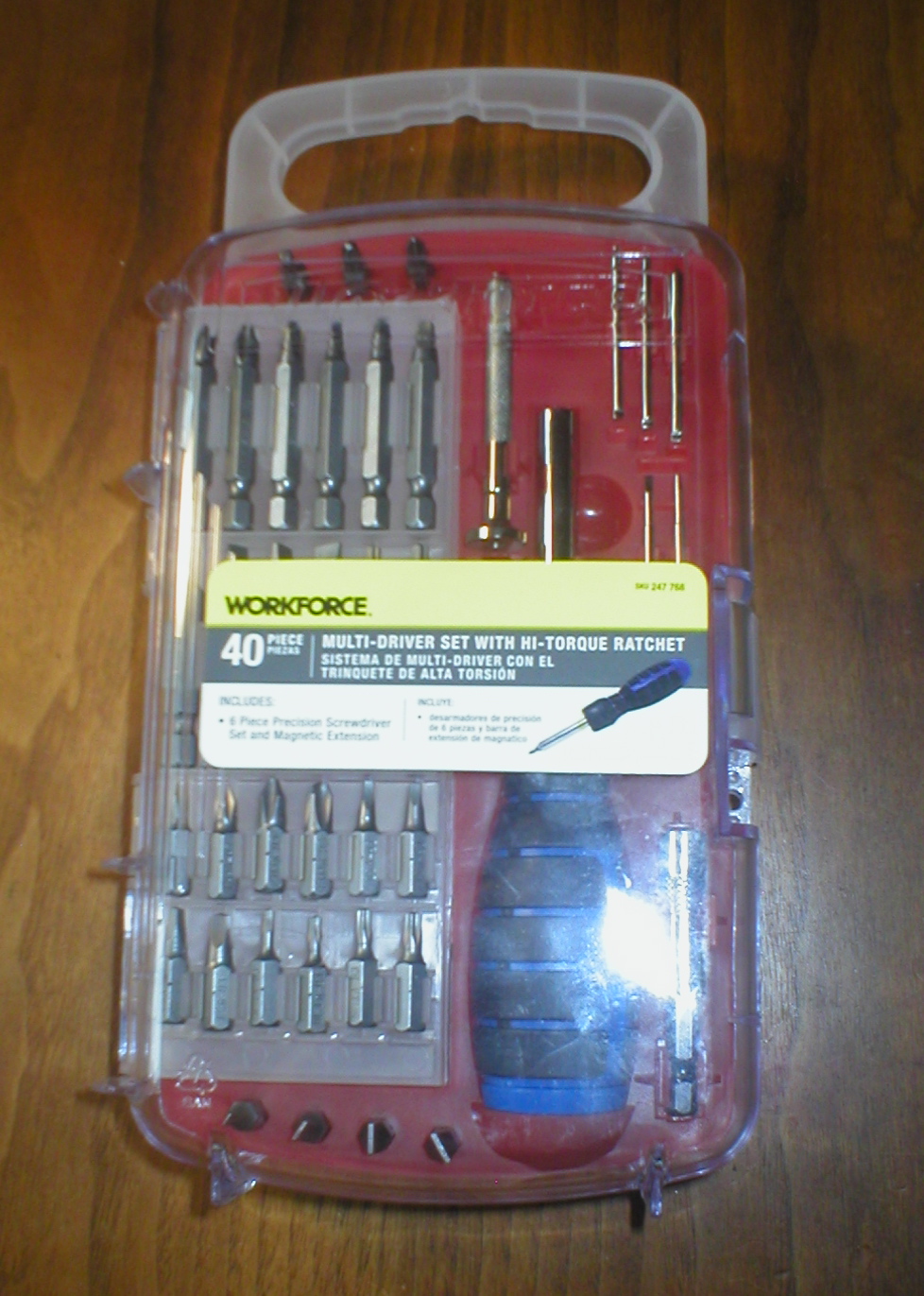
The China question is thrown into focus by products like the one pictured here. It is a 40-piece screw-driver set with a high-torque ratchet. The plastic cover opens to reveal an impressive array of tools, all nicely organized in a neat, rugged carrying and storage case. And of course, it was made in China.

The set, marketed under the trade name Workforce and offered by Home Depot, sells for $10.

Think of it: The 40 parts were manufactured in China, the case was made in China, the product was assembled in China, and the whole shebang was shipped to the United States, where Home Depot was able to sell it at a profit for $10! Now consider what the product would have cost if it was made in, say, Illinois.

Multiply that by the thousands of products made in China and South Korea and Thailand and Vietnam and sold in the United States, and the bottom line is hundreds of millions, if not billions of dollars of savings for American consumers. Politicians complain about the American jobs lost, but they rarely acknowledge the other side of the ledger.

What's more, many American companies, especially in high tech, depend on overseas markets for 40 or 50 percent of their sales. Is it realistic to expect these companies not to staff their foreign sales and service centers accordingly? At General Motors, the fastest-growing market these days is China. Does anyone complain that GM is exporting sales and service jobs to China?

So, the next time you hear a politician thunder about "getting tough" with China, ask yourself what the consequences of getting tough will be. If someone seriously suggests risking a trade war, let him or her prepare the American public for soaring prices on a long list of manufactured products - and for a long list of unintended consequences. Our relations with China are not perfect, but they are pretty good - for the moment.

Sunday, July 01, 2012

Olio

The 1934 version of The Painted Veil, starring Greta Garbo, will be shown on Turner Classic Movies on July 29, if anyone would like to compare the various versions of this essentially strong story.........News reports say that the real-estate market is heating up in several areas, and friends who are in the business in suburban Boston attest to this. Around here there is an absolute building frenzy. People are tearing down respectable houses to make way for bigger and fancier houses, and the tradesmen's pickup trucks are parked down the street, 10 to 15 in a row, month after month, as the latest building bubble inflates.........I have watched three episodes of the highly praised new BBC series, Twenty Twelve, and I must say the praise is overdone. This is a comedy about the tribulations of the Olympics Deliverance Commission, a group of civil servants charged with getting London ready for its closeup in 2012. It is done mockumentary-style, with the ODC's leader, Hugh Bonneville (the Earl of Downton Abbey) surrounded by hopeless incompetents. (One wonders what the London Olympics establishment thinks of this series.) The British are masters of the miniseries, but Christopher Guest is still master of the mockumentary, and Twenty Twelve, despite moments of hilarity, is only so-so.........One day Wall Street is sure that Europe's financial crisis is terminal, the next day the market is sure that it was all a bad dream. Trading on headlines is always risky, but these days it is madness. Best bet is still to buy solid utilities, many of which yield 4 or 5 percent.........A pollster reports that, among young people, one-third are uneasy if they haven't checked Facebook for two hours, and another sizeable slice constantly feel their pockets to be sure they have their smart phones. Good or bad, society is changing............Back to the BBC, which has produced a wonderful series on the cosmos, tracing man's "knowledge" of the universe back to the ancient Greeks, through Copernicus, Kepler, Gallileo, Newton, and Hubble. No one does sort of thing better than the Beeb, which constantly proves that television can be more than Newton Minnow's "vast wasteland." Of course, one also must credit Public Television, which brings us so many of the Beeb's goodies...........I am told, reliably, that the production of South Pacific at the Ogunquit Playhouse is superb. Even though I have seen this show often, I will try to catch this one before it leaves..........And a must is the Biddeford production of Chess, due in a few eeeks.

Friday, June 15, 2012

The Painted Veil (movie)

Well, it was a good idea. The Painted Veil was an interesting story, and I thought it would make a better movie. Wrong. The movie was well acted and nicely filmed (in China, mostly), but it was a downer. It is one thing to read about a cholera epidemic on the printed page; it is quite another thing to watch one realistically portrayed on the screen. Somehow the story didn't seem as grim when one read the Somerset Maugham novella, but it's ultimately a sad story, despite the efforts of the heroic French nuns who, like most of the people in the area, are dropping like flies. (The Mother Superior is played by Diana Rigg.) The story is a tale of a bad marriage rescued against a backdrop of human devastation. Not a bad premise, but if the screenwriter was aiming at redemption, he missed.

Naomi Watts is an excellent Kitty, and Edward Norton is a passable but passionless Walter. The supporting cast is good, and the cinematography, shot in shades of blue, grey, and brown, is appropriately depressing. The Maugham ending, which I thought clumsy, was abandoned in the movie, which made do with a short scene in England, five years after Kitty leaves China. That was a significant improvement.

But it was definitely not a feel-good movie, and if you favor this type of entertainment, avoid this one.

Monday, May 28, 2012

The Painted Veil

-->

Somerset Maugham was a good story-teller, not, in my opinion, a good writer, but a very good story-teller. There’s a difference. Graham Greene was one of the best story-tellers (The Third Man, The Quiet American, The End of the Affair, The Heart of the Matter, etc), but as a writer he could not compare with Evelyn Waugh. Greene wrote with the screenplay in mind, and actually turned several of his novels into scripts, whereas Waugh’s movies rarely made good movies, the exception being the wonderful British miniseries Brideshead Revisited.

But back to Maugham. Recently a friend recommended a movie based on a Maugham story, The Painted Veil. I wasn’t able to see the movie (but will one day), but found the story in my library, in a volume called The Maugham Reader. At 200 pages, it is longer than the usual Maugham short story, but it is worth the time. Like most of Maugham’s work, it is stiffly written, but what a story! It was first made into a movie in 1934, starring Greta Garbo, but the version my friend recommended was the 2006 film, with Naomi Watts, Edward Norton, and Liev Schreiber. The drama takes place in China, and the movie was filmed on location. I’m sure that the movie was much better than the printed page, and I thought while reading it that it would have made an excellent subject for Merchant and Ivory. I was not overjoyed by the ending, but others will disagree. Anyway, the screenwriter may have altered the final scenes. I’ll have to see.

The story involves a flighty, attractive young English woman who, anxious to be married before her younger sister trots down the aisle, marries a bacteriologist whom she can barely tolerate. The two travel to Hong Kong, where the bacteriologist has a mid-level civil post. Bored to tears, the bride (Kitty) enters into a torrid affair with a fast-rising British magistrate. The husband, a dutiful, dull sort (but very intelligent), finds out, and in a confrontation agrees to a divorce on two conditions: The lover’s wife must also agree (in writing) to a divorce, and the lover must agree to marry Kitty once the decree is final. The bacteriologist (Walter) is far ahead of his wife in this game: As he expected, the lover wanted Kitty only as a plaything, not a wife, and he is much too ambitious to permit a scandal.

Walter then announces that his research will take him to the interior of China, where there is a cholera epidemic, and he wishes his wife to accompany him. I have told you enough. You will have to find the story at the library or, better still, find the 2006 movie. When I see it, I will let you know what I think.

Note: My thoughts on the movie appear in a blog dated June 15, 2012.